
Population aging is rapidly becoming one of the most intractable wicked problems of the 21st century. It is no longer a distant horizon, something that can be punted to future generations. Rather, many countries and societies are already grappling with it, and it is an uncertain landscape that many in the world are already walking through. Consider that while as of 2024 there were more than 46 million adults in the United States aged 65 and older, the projections are that this number will double by 2060 (Kabo et al., 2024). The United States is aging, and rapidly at that. But this problem is not isolated to the United States. Population aging is a global issue, though the severity of the crisis varies by country and region. Across Organization for Economic Co-operation and Development (OECD) countries, the population share of adults aged 65 and older is projected to increase from 18.5% in 2023—more than 252 million people—to 26.4% on average by 2050, even exceeding 33% in some countries (OECD, 2024, 2025).
Against this backdrop, we need to come to terms with how the built environment is indispensable to resolving the complex problem of population aging. But first, let’s define the built environment. The simplest definition of the built environment is that it comprises those aspects of the physical environment that have been created and modified by humans, and that have been integrated into the natural environment. That covers buildings and structures, transportation infrastructure (e.g., roads, rail, bridges, ports, airports, etc.), utility infrastructure (e.g., water, sewer, telecommunications, energy, etc.), and so on. This special issue focuses on buildings and structures, at multiple scales, and in different contexts. The articles in this issue of Generations Journal examine how the built environment is a powerful determinant of aging well in ways that are of interest to a global audience. Even though most of the articles focus on the United States, several focus on Canada, Sweden, and the world at large.
We need new mindsets, approaches, and solutions. Now. This issue features articles by scholars, designers, and practitioners that illuminate how built environments shape autonomy, identity, belonging, health creation, and social connection.
This issue responds to the demands of rapidly aging societies by spotlighting the need to redesign the built environment and spatiosocial supports for older adults, and a shift from traditional models toward integrated, equitable, human-centered places that enable everyone to thrive. Collectively, the authors wrestle with weighty questions such as “what types of places are needed to better support aging societies?” And the corollary to that would be “for whom are we designing those places?” versus “for whom should we be designing them?” Our societies are aging rapidly, unevenly, and in ways that expose the profound mismatches between how our environments were designed and what later life now requires. The places where aging is currently unfolding—homes, neighborhoods, long-term care settings, cities, etc.—were largely built for a different era, and were shaped by outdated assumptions about family structure, health, independence, and community.
We need new mindsets, approaches, and solutions. Now. This issue features articles by scholars, designers, and practitioners that illuminate how built environments shape autonomy, identity, belonging, health creation, and social connection. The authors help us envision and reimagine how built environments, including some that are currently viewed as failing or underperforming, can be treated as non-pharmacological interventions that can help older adults thrive by positively impacting health, well-being, and aging.
The opening articles lay the foundation for the argument that an older future demands a fundamental redesign of the built environments and spatiosocial systems that shape later life. Migette Kaup identifies the stakes by highlighting that, given demographic realities and inequities in long-term care, the built environment must be understood as a core part of the care system itself, not as an accessory to it or a “nice-to-have” factor. Rachel DeSanto then reframes successful aging through an equity-centered salutogenic lens, asking whose health is supported, and at what cost.
Following this are four articles that present holistic, integrated models of practice that treat housing, healthcare, and community as elements of a single ecosystem rather than as separate siloed domains. Dina Battisto et al. use theory and research to develop Healthy Environments for Aging, Resilience, Thriving, and Hope (HEARTH), a village-based, comprehensive model for humans flourishing in older adulthood that integrates housing, healthcare, wellness, and community. Margaret Calkins et al. discuss Thome Rivertown in Detroit, Michigan, a real-world example of an integrated model for low-income older adults that combines PACE and affordable housing. Elika Herischi uses the West Park Healthcare project in Toronto, Ontario to extend the conversation into post-acute and rehabilitation environments, showing how biopsychosocial design can transform recovery and daily life. Elisabeth Perreault examines how the 240-bed Veterans Home of California, Yountville, a skilled nursing and memory care facility, fully embodies the biopsychosocial model through small-household design, universal design principles, intuitive wayfinding, and rich indoor–outdoor environments.
The next three articles touch on issues related to home, identity, and community. Daejin Kim examines why aging in place through home modifications is failing those who need it the most, and in doing so exposes systemic barriers in access, affordability, and education. Next, Peggy Chi and Oskar Jonsson use a comparative, cross-country lens of Canada and Sweden to explore culture, identity, and the theory of prospect and refuge across home, community, and long-term care settings. Natalie Verdiguel deepens and enriches the discussion through a unique perspective on designing for attachment, identity, and belonging in immigrant communities through research-based frameworks on place attachment.
The authors in this journal make a compelling, collective argument that not only is population aging a future and current issue, but that aging well will be shaped not only by policy and programs, but also by the built environment.
Finally, the last set of articles in this journal issue zoom out to focus on the urban scale, and on spatiosocial infrastructures. Brian Schermer challenges us to envision failing retail landscapes as intergenerational communities of care in which we have unique opportunities to not only repair the built environment, but also to reconnect housing, caregiving, and social infrastructure. Emily Cerny offers a speculative but research-informed model for aging-ready adaptive reuse of office towers into “Vertical Villages” that align with the “15-Minute City” concept that has quickly gained popularity since the COVID-19 pandemic (Moreno et al., 2021). Cameron Contreras rounds out the articles by broadening the urban systems lens to challenge traditional development or renewal patterns that are ill-suited for using the built urban environment to promote the needed systems-level changes to failing social infrastructures.
The authors in this journal make a compelling, collective argument that not only is population aging a future and current issue, but that aging well will be shaped not only by policy and programs, but also by the built environment. They make a persuasive case that aging is not simply a biological process, but a spatiosocial one, with the built environment acting as an active contributor to healthy and successful aging. Importantly, if we design built environments that support and enhance dignity, autonomy, identity, and connection for older adults, then we can create places where people of all ages and abilities can thrive.
In addressing the broader issue of why it is imperative that we plan for and invest in designing, retrofitting, and reimagining the built environment to better support the needs of older adults, the authors in this special issue do not offer a simple, universal blueprint. Nor should they, if the goal is to move society beyond the tendency for solutions where the quality of a place is mainly determined by income, geography, or luck. Instead, they invite readers to see the built environment as everyday health infrastructure, and to treat dignity, belonging, and social connection and participation as non-negotiable for successful aging in place, in community, and in care settings.
Felix Kabo, PhD, MArch, MSc, is the R&D Director at CannonDesign and Senior Impact Designer in Residence at the Ross School of Business at the University of Michigan. His work on aging and older adults has been supported by the Ewing Marion Kauffman Foundation and the National Institute on Aging, and he was a 2014 fellow of the Michigan Center for Urban African American Aging Research (MCUAAAR). Kabo has served as principal investigator for multiple studies using national datasets from the Health and Retirement Study (HRS) and the Understanding America Study (UAS), examining older adults with respect to entrepreneurship, social networks, and health equity. He also leads cross‑sector collaborations on the future of aging societies, convening experts across architecture, health care, gerontology, technology, business, and public policy to advance research and design strategies that promote health, well‑being, and human flourishing across the life course.
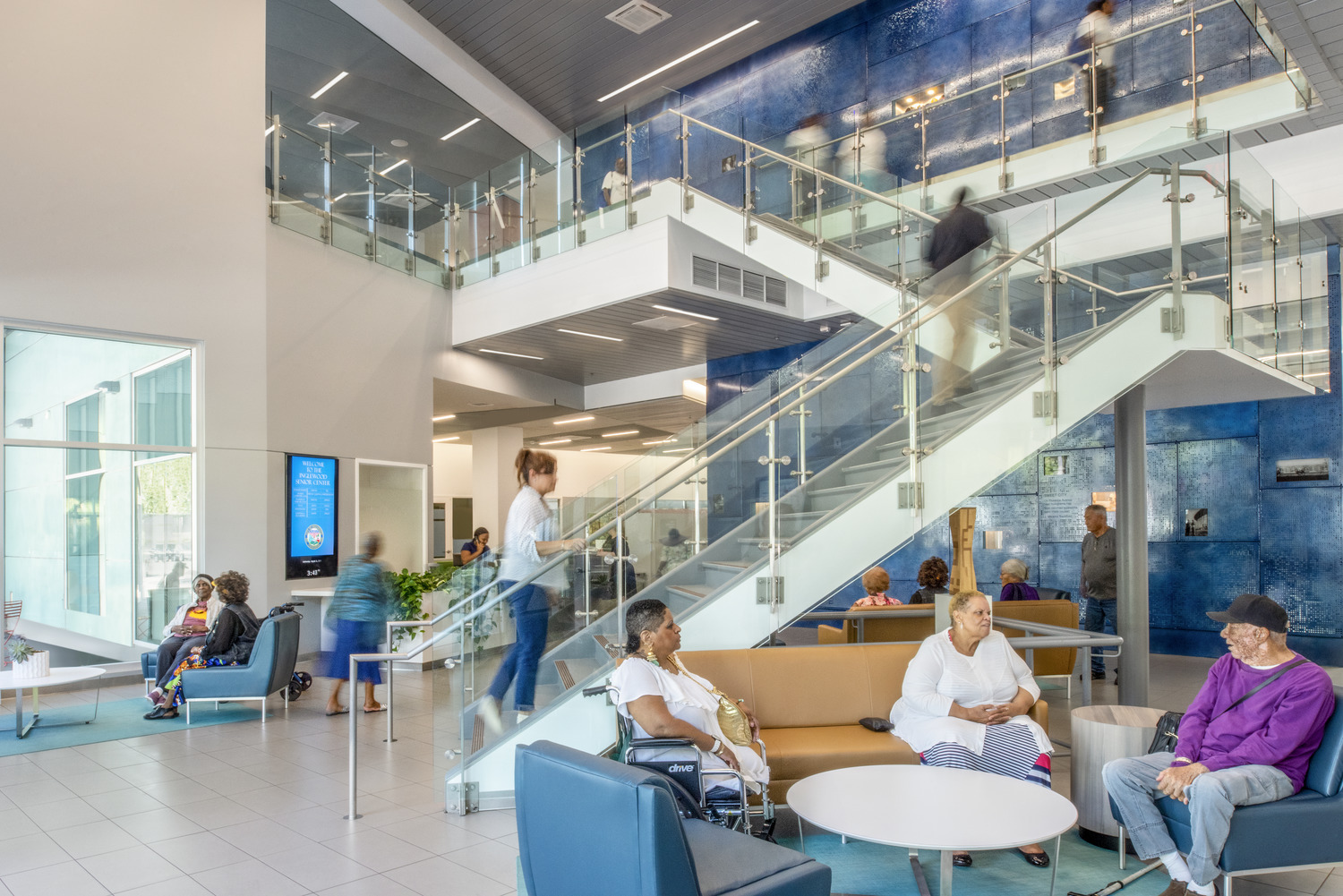
Photo credit: Inglewood Senior Center by Laura Peters/CannonDesign
References
Kabo, F., Morrison, J., & Ritsema, C. (2024). Dual priorities: Digital twins and health care design that supports older adults in the context of staffing shortages. Innovation in Aging, 8(Supplement_1), 617–618. https://doi.org/10.1093/geroni/igae098.2022
Moreno, C., Allam, Z., Chabaud, D., Gall, C., & Pratlong, F. (2021). Introducing the “15-minute city”: Sustainability, resilience and place identity in future post-pandemic cities. Smart Cities, 4(1), 93–111. https://doi.org/10.3390/smartcities4010006
OECD. (2024). Is care affordable for older people? OECD Publishing.
OECD. (2025). Health at a glance 2025: OECD Indicators. OECD Publishing.