
For too long, programs and policies affecting older adults have been designed for communities rather than with them. But older adults are not only the people most affected by these decisions; they are also essential leaders in shaping them. They bring deep knowledge of their neighborhoods, firsthand experience navigating challenges, and a clear vision for what healthy aging can look like. When organizations create real opportunities for older adults to lead, communities become stronger, more responsive, and more equitable.
That belief is the foundation of Community-Led Change for Older Adults: A Toolkit for Community Organizing, a new resource from The SCAN Foundation designed to help organizations engage older adults as partners, advocates, and changemakers. Developed with input from Equity Community Organizing (ECO) Group members and staff, the toolkit provides practical guidance for organizations seeking to bring older adults together to identify local challenges, co-design solutions, and advance health equity.
Why Community-Led Change?
Community-led change begins with a simple but powerful idea: the people closest to a problem are often closest to the solution.
Across the country, communities are working to address challenges that affect older adults, from housing and transportation to social isolation and access to health care. While institutions and service providers play important roles, the most effective solutions are often those shaped by the experiences of the people directly impacted by those challenges.
Community-led change begins with a simple but powerful idea: the people closest to a problem are often closest to the solution.
Community organizing creates a structure for residents to come together, build trust, identify priorities, and take collective action. Rather than asking community members to react to pre-determined solutions developed without their input, community-led approaches elevate local expertise and support residents in defining what change should look like.
For older adults, this matters especially because aging experiences are not the same for everyone. Systemic barriers related to race, ethnicity, income, geography, language, and disability can impact one’s ability to age well. Community-led organizing helps ensure that efforts to address inequities are informed by lived experience and grounded in community priorities.
Why Engage Older Adults?
Older adults are frequently invited to participate in surveys, focus groups, or advisory conversations, but are rarely given meaningful opportunities to lead. The toolkit challenges organizations to think beyond engagement and toward partnership.
Older adults possess valuable knowledge about their communities, including what services are working, where gaps exist, and what changes could have the greatest impact. They also bring relationships, networks, and historical perspectives that can strengthen community-driven efforts.
The experience of the ECO Groups demonstrated that when older adults are supported as leaders, they become powerful catalysts for change. Participants not only identified community challenges but also built connections, developed solutions, and strengthened local leadership.
The benefits extended beyond community action. Participants reported finding connection, purpose, and belonging through their involvement. As one ECO Group participant shared, “The more we participate … the more positive change is possible in the community.” This highlights the profound social and personal value that can emerge when older adults are given meaningful opportunities to contribute and connect.
The ECO Groups: A Community-Led Model in Action
The toolkit is grounded in the experiences of four ECO Groups established through support from The SCAN Foundation, California Health Care Foundation, and Metta Fund. These groups brought together older adults from historically marginalized communities across California to identify health inequities and develop community-driven solutions.
The four groups included:
- Booker T. Washington ECO Group in San Francisco
- Sankofa Elders ECO Group in Los Angeles
- Cloverdale ECO Group in Northern Sonoma County
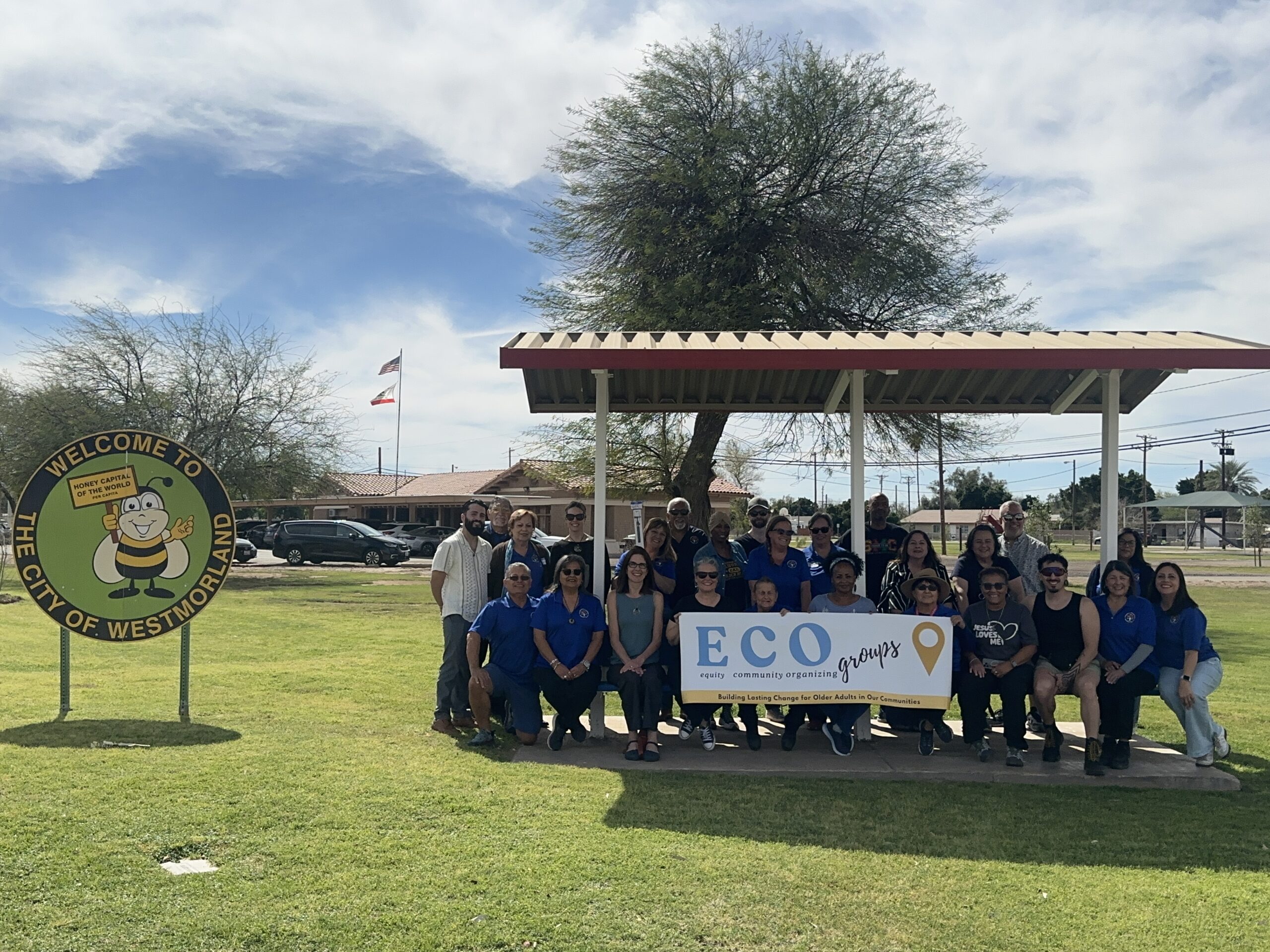
- Imperial Valley ECO Group in Imperial County
Over approximately 18 months, members met regularly to discuss community concerns, identify priorities, and explore opportunities for action. As a learning partner, Providence CORE captured observations, feedback, and lessons from the groups’ experiences. Those insights became a central foundation for the toolkit. While the ECO Groups shared a common organizing approach, each group’s work reflected the distinct strengths, challenges, priorities, and relationships of its own community. That variation is part of what shaped the toolkit’s flexible design.
One lesson emerged consistently across all four communities: meaningful change requires trust. Community members needed time to build relationships, learn from one another, and develop a shared vision before moving into action. The ECO Groups showed that investing in relationship-building is not separate from community change work. It is essential to it.
A Practical Resource for Communities Ready to Take Action
What makes the toolkit particularly valuable is its focus on implementation.
The toolkit walks organizations through nine stages of community organizing, from defining a group’s purpose and recruiting members to taking action, evaluating progress, and planning for long-term sustainability. Each section pairs step-by-step guidance with practical tools informed by established community organizing principles and lessons drawn directly from the ECO Groups.
In addition to step-by-step guidance, the toolkit includes a robust collection of worksheets and planning tools that organizations can immediately put into practice.
For example, users will find worksheets that help assess organizational readiness, clarify goals, and identify the unique purpose of their group before launching an organizing effort. Other tools support recruitment planning, meeting design, accessibility considerations, and the creation of group norms that build trust and foster meaningful participation.
As groups move into identifying priorities, the toolkit includes structured exercises for exploring health inequities, prioritizing issues, and mapping community assets and power structures. These tools help participants better understand the systems, organizations, and decision-makers that influence community conditions and identify opportunities to create change.
One lesson emerged consistently across all four communities: meaningful change requires trust.
The toolkit also provides resources to support co-design and action planning. Facilitator checklists, strategy worksheets, and action-tracking tools help groups move from discussion to implementation while maintaining a clear focus on community priorities. Additional worksheets support evaluation, communications planning, and sustainability, helping organizations document progress, share successes, and build momentum over time.
Importantly, these worksheets are not theoretical exercises. They were informed by the real-world experiences of the ECO Groups and designed to help organizations adapt community-organizing practices to their own local context. Whether an organization is just getting started or looking to strengthen an existing community engagement effort, the toolkit offers practical resources that can be tailored to different communities and goals.
Building a Future Where All Older Adults Can Thrive
The challenges facing older adults are complex, but communities already possess many of the ideas, relationships, and strengths needed to address them. The key is creating opportunities for those voices to lead.
The toolkit translates lessons from the ECO Groups into a practical resource that helps organizations create the conditions for older adults to lead community change. For community-based organizations, advocates, funders, and local leaders looking to deepen community engagement and advance health equity, the Community-Led Change for Older Adults Toolkit offers both inspiration and a roadmap. More importantly, it provides the concrete tools needed to move from intention to action.
We encourage you to explore the toolkit, download the worksheets, and consider how these resources can support your work. By investing in community-led change and elevating the leadership of older adults, we can build stronger, more inclusive communities where everyone has the opportunity to age with purpose, connection, and dignity.
Erin Westphal serves as the Director of Policy, Programs, and Operations at The SCAN Foundation. In this role, she helps advance the foundation’s mission to ignite bold and equitable changes in how older adults age by leading initiatives that strengthen the integration of medical and social care.
Olivia Burns, MSW, serves as the Senior Policy Analyst for The SCAN Foundation. In this role, she supports the foundation’s policy, communications, and program staff by tracking and analyzing trends in federal and state policy, communications, and programmatic efforts that may impact the continuum of care for older adults, people with disabilities, and their family caregivers.
Photo credit: Courtesy of The SCAN Foundation