
The operation had gone well. The discharge recommendations were clinically sound: six medications, daily wound care, a walking schedule, dietary changes, and a clinic visit in ten days.
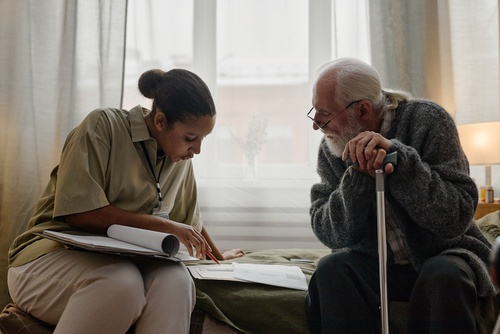
Then the patient’s daughter opened a small notebook. She lived nearly two hours away. His wife had severe arthritis and could not safely help him out of a chair. Neither of them drove. The medication labels were difficult for him to read, and the family was already deciding which expenses could wait until the end of the month.
Every instruction was medically reasonable.
Together, they formed a plan no one at home could reliably carry.
This composite scene reflects situations I encountered repeatedly during more than three decades in cardiovascular surgery. When recovery did not proceed as expected, the chart might later contain a familiar word: nonadherence. Sometimes that description was accurate. But sometimes it ended the inquiry too early. The failure had begun before the patient missed an appointment or confused a medication. It began when we designed the plan without asking whether ordinary life could sustain it.
A Growing Workforce We Rarely Assess
The 2025 Caregiving in the US report estimates that 63 million Americans, nearly one in four adults, are family caregivers. More than 40% provide high-intensity care, yet only 22% receive training for the complex responsibilities they may assume. Many manage medications, equipment, appointments, symptoms, finances, and personal care while also trying to protect their own health and employment.
A 2026 AARP analysis estimates that family caregivers of adults provided 49.5 billion hours of care in 2024, work valued at approximately $1.01 trillion.
These figures describe more than generosity. They reveal a largely unpaid care infrastructure on which clinical plans increasingly depend.
We have become skilled at assessing the patient’s diagnosis, laboratory results, surgical risk, and functional status. We are less consistent in assessing the capacity of the household expected to carry the treatment after the clinical encounter ends.
Care Has Moved Home
This shift is partly the result of medical progress. People survive illnesses and procedures that once killed them. Hospital stays are shorter. Chronic conditions are managed for years. Medications, wound care, rehabilitation, monitoring, and symptom surveillance increasingly take place beyond institutional walls.
But responsibility has moved faster than support.
The hospital provides the intervention. The household inherits the continuity. A spouse becomes a medication manager. A daughter organizes transportation and coordinates care. A neighbor becomes the first person to notice confusion, swelling, or breathlessness.
None may think of themselves as part of the healthcare workforce. Yet the success of the plan may depend on them.
This is why “nonadherence” requires careful use. The term can describe what happened, but not necessarily why. A patient may decline treatment, misunderstand it, experience intolerable side effects, or make a considered choice that differs from the clinician’s recommendation. Those distinctions matter.
A care plan is usually judged by whether its recommendations are clinically appropriate and evidence-based. That is necessary, but incomplete. Quality must also include feasibility.
But before locating failure in the individual, we should ask whether the plan exceeded the capacity available to carry it.
Capacity is not the same as motivation. It depends on time, physical strength, attention, health literacy, money, transportation, safe housing, digital access, and reliable help when circumstances change.
It also fluctuates.
The caregiver who can manage today’s routine may be unable to absorb a new medication, a fall, a sleepless week, or another family crisis.
Capacity Belongs Inside Care Quality
A care plan is usually judged by whether its recommendations are clinically appropriate and evidence-based. That is necessary, but incomplete. Quality must also include feasibility.
Can a plan be considered high-quality if the older adult and family expected to carry it have no realistic means of doing so?
The Centers for Medicare & Medicaid Services’ Guiding an Improved Dementia Experience, or GUIDE, Model offers an important signal. It incorporates care navigation, caregiver education, respite services, round-the-clock support, and screening for psychosocial and health-related social needs, including barriers involving meals and transportation.
The model is still being evaluated, so its outcomes should not be assumed. But its design recognizes a principle that should extend beyond dementia care: caregiver needs and community resources are not peripheral to the clinical plan. They are part of its operating conditions.
For aging-services professionals, the practical question is not simply whether a recommendation is sound. It is whether the people expected to carry it have the capacity, support, and backup to do so.
Before a care plan becomes someone else’s daily work, four questions deserve explicit answers:
Who will perform each task?
What will it require in time, money, strength, knowledge, and coordination?
Where is the plan most likely to break?
Who will notice first, and what happens then?
Medicine has become very good at producing technically correct plans. Aging-services professionals can help make those plans livable by bringing the realities of everyday life into the very definition of quality.
These questions can be incorporated into existing assessment and care-planning processes. What matters is treating the capacity available at home, caregiver readiness, and access to community support as clinical information rather than background context.
If transportation is unavailable, follow-up has not truly been arranged.
If an older spouse cannot safely provide physical assistance, mobility advice has not yet become a rehabilitation plan.
If a family member is expected to manage injections, dressings, or medical equipment without training, responsibility has been transferred without a safe handoff.
And if no one knows whom to call when symptoms change, continuity has already begun to fail.
The response is not to lower standards or abandon appropriate recommendations. It is to design plans that distinguish the essential from the desirable, include caregivers with the older adult’s consent, simplify tasks where possible, connect families to community resources, and establish an early checkpoint before a small difficulty becomes a crisis.
Feasibility is where inequity becomes visible.
A plan that quietly assumes a flexible job, a private car, a nearby adult child, reliable broadband, safe housing, and spare money places unequal burdens across households. When those assumptions remain invisible, disparities may be mislabeled as poor engagement, irresponsibility, or personal failure.
The problem is not solved by asking families to try harder. Nor is it solved by handing them longer instructions at discharge.
It requires clinicians and aging-services professionals to treat the home, caregiver, and community as part of the setting in which care succeeds or fails.
Medicine has become very good at producing technically correct plans. Aging-services professionals can help make those plans livable by bringing the realities of everyday life into the very definition of quality.
A medically correct plan that cannot survive ordinary life is not yet a complete plan.
Mustafa Kemal Çalık, MD, is a cardiovascular surgeon and digital health consultant. He has contributed to community-based healthy-aging initiatives, including İzmir’s Elderly Action Plan, addressing social participation, sustainable care, and support for older adults and sandwich-generation caregivers. His current work examines what happens after technically successful care enters the realities of homes, families, and communities.
Photo credit: Shutterstock/SeventyFour