

A Home Visit
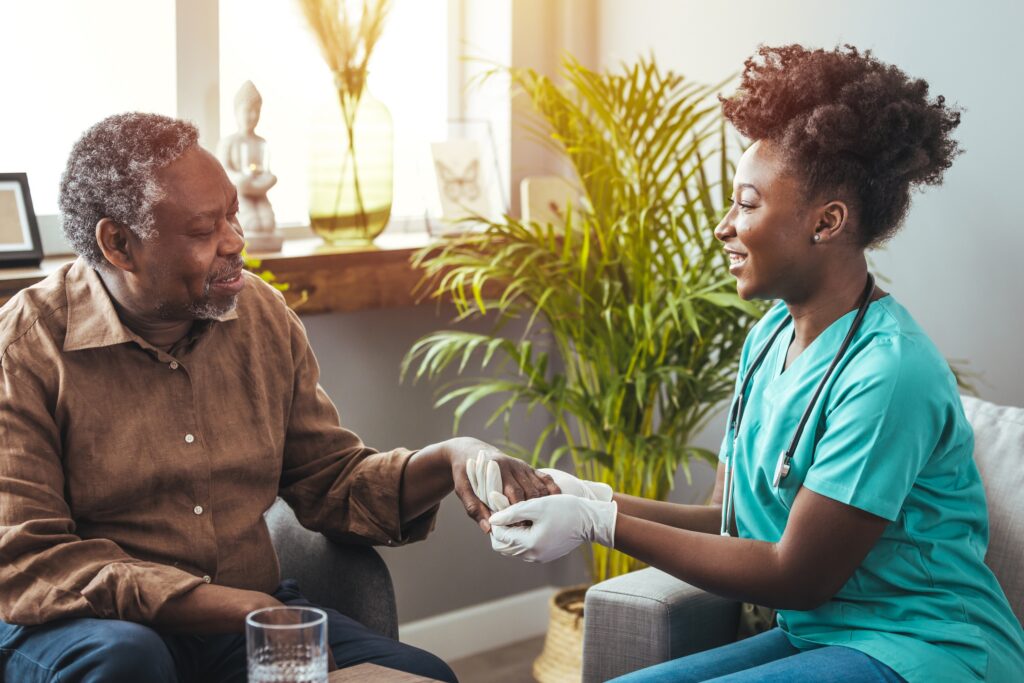
I can smell the coffee being made as I walk up the front pathway—an offering always extended to me upon entry. I am greeted by a gray cat who weaves around my legs as I remove my shoes and set them near the door. I have my camping stool over my shoulder, and my doctor’s bag across my body, filled to the brim with supplies for our visit together. In the home, I am the medical assistant, nurse, office manager, physician, social worker, and friend.
The living room has been transformed into a bedroom, though reminders of its prior form are evident. A chair in the corner, a coffee table pushed up against the wall. Medications now lined up along a side table where coasters, an angel figurine, and remote controls once sat. There is gentle murmuring on the television, the sound turned low to accommodate our conversation. A care partner greets me with a tired, knowing smile, an offering of refreshments, and small talk about the weather and the Ravens game this past weekend.
We are hopeful Lamar will be back and feeling well for next week. My patient sits up in the hospital bed mid-room. Their hair is combed, slightly wet from the bed bath they just received. On the basin nearby, the lotion used to massage their legs and feet is still open. I have been the closest to holiness when I have watched a care partner perform daily care activities for their bedbound loved one. It is love in action. Love as a verb. We begin where we last left off. There is only so much I can do in these visits, but there is much I bear witness to.
A Call to Rethink Current Systems of Care
I spend most of my days caring for older adults at home. In this work I get to step into the lived experiences of my patients and their care teams. This experience has completely shifted my perspective on the traditional medical models, which I believe miss the mark. The future of geriatric medicine is community care and collectivism. Our systems of care are only as strong as the ways we build them to support every member of society from birth until death. Currently, care of older adults at home is individualistic because our systems don’t prioritize this care as central to our society’s well-being. To change the way we think about this is to change our collective futures.
I have ideas for how we can dismantle current approaches to older adult care. To do this, we must first shine a light on the challenging juxtapositions that exist in our medical establishment. While my lens is acutely focused on those who are homebound, these ideas span the entirety of elderhood.
Longevity Versus Quality of Life
Much of current work in aging and medicine focuses on longevity. How do we extend life spans? My questions are: How do we also extend meaning, connection, and quality of life? How is this work of building longevity forgetting the most at risk among us? How do we account for what matter most to our elders?
As clinicians, a life well-lived is not ours to define. It is shaped by individuals and their histories, relationships, cultures, and values. It is often revealed not in clinical metrics but in the lived experience of their daily lives. Our role is not to assume or prescribe what a good life should look like, but to make space for patients to articulate it, and to listen closely. This may happen through small, deliberate acts: asking what matters most, noticing what surrounds them, understanding how they spend their days, and aligning care with those priorities. In this way, a life well-lived is not a fixed endpoint but something we come to understand in partnership, over time. This is as important as (or perhaps more important than) a life lived longer.
Precision Medicine Versus Social Reality
So much of the future of aging and health is focused on the new technologies and biomarkers. These innovations are remarkable and changing the face of how we care for older adults and provide precise and focused care within health systems. But the reality for patients is that biomarkers and technologies only account for one small portion of their story. When we focus on these precision modalities without also acknowledging the very real lived experiences of older adults, including gaps in housing supports, caregiving resources, and transportation, we are only addressing one small portion of their health and medical care.
‘As clinicians, a life well-lived is not ours to define.’
For clinicians, this means expanding our approach beyond what can be measured. It means routinely exploring the barriers patients face in their daily lives, incorporating observations of the home and community into clinical reasoning, and designing care plans that reflect not only clinical goals but also lived realities. It may require partnering more intentionally with caregivers, social services, and community resources, recognizing that good care extends beyond the walls of the clinic. In doing this, we begin to bridge the gap between precision medicine and the complex, contextual lives of the older adults we serve.
Innovation Versus Exclusion
Along similar lines, in medicine, particularly in academic medicine, we often focus on innovations. Innovations that center older adults and their care partners are important and essential to the future of healthcare. But far too often they do not account for older adults most in need of supports, those who are homebound, cognitively impaired, have low digital literacy, or who live at the intersection of multiple marginalized identities. These exclusions do not occur randomly. They fall along predictable lines of race, income, disability, geography, gender, and immigration status. Aging magnifies existing inequities. It does not erase them. True innovation is translational and tries to reach and support everyone in the communities we serve (Parker et al., 2025).
Fragmented Versus Relational Care
Much of healthcare structure centers institutions—clinics, hospitals, research centers. These institutions shape the agenda for the future of aging and health, but they are not situated where patients spend the majority of their time: in communities. When we center institutions we also center fragmented, episodic care that is often siloed and not relationship-centered or longitudinal. Care that follows people over time and reaches into communities to connect and support people across time is care that bolsters our elders and our future.
What would it look like to build systems that follow people rather than wait for them? Moving toward this vision requires a reorientation of care: Investing in home- and community-based models, building longitudinal relationships that extend beyond single encounters, and partnering with the networks that already support patients in their daily lives. By doing so, we can shift from a system that patients must navigate to one that meets them where they are.
A Liberation Framework for Care of Older Adults
Care for our older population is a public good and a collective responsibility. This means decentering healthcare systems as the only way care happens. It is a small but essential part of the way we think about aging well. Aging is relational and calls for systems designed around interdependence and strong community infrastructure. The concept of age-friendly health systems is a start, but remains centered on healthcare systems (Fulmer et al., 2018; Tinetti et al., 2017). I believe a core part of this is making the home the center of health and requires the act of designing care from the home outward (Counsell et al., 2006).
Justice-oriented geriatric care models focus on trauma-informed and age-friendly care (Santos-Costa et al., 2025; Kennedy et al., 2026). This extends outside health systems and into communities where people exist. This involves investment in public health and social care, investment in caregiving as something for which we compensate and support people (Perone et al., 2025). It means prioritizing quality medical and social care, time spent with people in their homes and shared community dwellings where they live and thrive. Removing fee-for-service models that dictate time as a commodity, which we never have enough of (Elf et al., 2017; Ouslander et al., 2024).
‘I believe a core part of this is making the home the center of health.’
Focusing instead on quality time spent in care is the greatest deciding factor between sickness and well-being. This sounds audacious when it’s written down, but it is the only way we can create a sustainable future for ourselves and for future generations of aging adults.
I believe that art and creativity are essential to this liberation framework. The capacity to wonder should be a clinical skill that every clinician is encouraged to foster in themselves. Wonder slows us down in systems that reward speed. It allows us to see people rather than problems. In homes and communities, where complexity cannot be abstracted, wonder becomes a diagnostic tool and a pathway to connection. The act of narrating and documenting is essential. The use of art in medicine is part of connection. The capacity to connect and dialogue across differences is part of creating the future we want.
In our work at Johns Hopkins, we integrate Visual Thinking Strategies (Balhara et al., 2023; Chisolm et al., 2023; Zheng et al., 2024) into geriatrics education to cultivate these skills intentionally. A simple facilitation using three core questions—What is going on in this picture? What do you see that makes you say that? What more can we find?—could unlock a world of shared exploration and discovery. Using visual art and the home environment as art, students practice careful observation, articulating what they see and grounding their interpretations in evidence, while remaining open to alternative perspectives. Over time, this practice translates into clinical care: noticing the details of a patient’s environment, asking more curious and less assumptive questions, and building shared understanding with patients and caregivers. In the home, where the clinical and the personal are inseparable, these skills become essential. Art becomes not an adjunct, but a training ground for the kind of attention and connection that good care requires.
A future of geriatric care that doesn’t cultivate imagination will reproduce the same inequities with new technologies.
How to Create the Change We Need
MACRO (Policy and Financing):
At the macro level we need to focus on policy and infrastructure that centers the community care we want. This means investing in home-based primary care and reform for long-term care. This also includes paid caregiving as a national infrastructure and creating housing that’s affordable, plus policy focused on mixed-use and intergenerational housing. Paid family leave, respite care, and caregiver training should be treated as core components of health policy, not optional social services. We must build community infrastructure that centers aging-in-place with less siloed approaches to care, which only waste resources and miss opportunities to collaborate. We need to do on a macro level what we do so well in our interdisciplinary teams, which is collaborating across sectors, particularly between social work, medicine/nursing, public health, and housing and development/design.
MESO (Health Systems and Training):
At the meso level we need to transform the way we train clinicians to center homes and communities, not just hospitals and clinics. Every trainee should complete longitudinal home-based care as part of their training program. This means holding health systems accountable for more than delivering health care, but also for fostering and centering social connection as essential to care. It involves community partnerships that allow for shared understanding, meaning-making, and collaboration. Additionally, it means leveraging the skills of interdisciplinary teams and acknowledging the differences and importance of our diverse training. We should also bring public health into clinician training and ensure a universal understanding of the structures and systems that impact our patients. Ideally, this training should infuse the arts and humanities into workforce development to help ensure it remains relational. Clinical competencies that require the arts and humanities are essential to training the future healthcare workforce.
MICRO (Clinical Practice and Professional Identity Formation):
On the micro level we must build training programs that remove the traditional deficits-based mindset and center anti-ageist care. This includes the core tenets that listening is an intervention and curiosity and humility are necessary to understanding the lived experience of our patients. Being curious should be at the core of diagnostic and clinical reasoning. The answer always lies in knowing the person in front of you as a whole person. To really make this possible, we need to include patients when creating these training programs. Understanding the lived experience and incorporating shared meaning-making into training will help build professional identities that look beyond only the identity of clinician.
A Call to Community Care
The work of caring for older adults, truly caring for them, does not happen primarily in hospitals or clinics. It happens in the homes and communities where people spend most of their lives. Sitting in my patients’ homes, alongside their care partners, is a gift and a responsibility. It is what drives me to build systems worthy of the people we serve. Because that care partner is exhausted. Because they are stretching beyond their capacity to make this life possible. Because many of my patients have spent every last dollar to remain in the place they call home. They are often one crisis away from everything falling apart.
‘A future of geriatric care that doesn’t cultivate imagination will reproduce the same inequities with new technologies.’
It is in these homes that I see structural inequities most clearly. Where housing, income, race, and access shape the final chapters of life. Where social and structural forces determine whether aging is marked by dignity or struggle. This should never be the case in a society that claims to value its elders.
Much of what shapes these experiences lies beyond the traditional boundaries of medicine. Community-based organizations, housing programs, and caregiving networks are already doing this work, often without the support or resources they need and deserve. For those of us in medicine, particularly academic medicine, the work is not to extend our reach unilaterally, but to build meaningful partnerships by listening to, investing in, and aligning with the community infrastructures that already sustain patients’ lives (Ravaghi et al., 2023). There are models for such partnerships we could use as a guide (Bess et al., 2024; Khatib et al., 2025). The future of aging depends upon how well we learn to share this work.
The gift of entering my patients’ sacred spaces is that they remind me how small my individual impact is, and how expansive our collective responsibility must be. They remind me that the future of aging will be shaped not only by medicine but by the choices we make as communities. By the systems we build. By the imagination we allow ourselves. Because in our dreaming, we are shaping our own collective future.
Returning to the Home Visit
I step back out into the sunlight of a beautiful Maryland fall day. I sit in my car (my office) for a few moments before driving to the next home. I think about the visit, what we can offer, what I wish we could offer, what I witnessed, the holiness of it all, and my gratitude for this work and this day. There is much to be done.
Mariah L. Robertson, MD, MPH, is an assistant professor at Johns Hopkins Bloomberg School of Public Health, trained in public health, internal medicine, and geriatric medicine. She conducts clinical and educational work in the home-care setting.
Photo credit: Shutterstock/noerbtr1
References
Balhara Philip, K. S., Yenawine, P., Irvin, N., Eller, L., Habib, L., Tatham, C., & Chisolm, M. (2023). Facilitating difficult conversations through art: creating an anti-racism digital image library for health professions education. International Review of Psychiatry, 35(7–8), 623–630. doi: 10.1080/09540261.2023.2252920
Bess, C., Ferdinand, D., Underwood, P., Ivy, D., Albert, M. A., Onwuanyi, A., McCullough, C., Brewer, L. C., & Association of Black Cardiologists Community Programs Committee. (2024). Promoting cardiovascular health equity: Association of Black cardiologists practical model for community-engaged partnerships. Journal of the American College of Cardiology, 83(5), 632–636. doi: 10.1016/j.jacc.2023.11.025
Chisolm, M. S., Duke, L., and Stephens, M. B. (2023). Visual thinking strategies in medical education: Staying open to possibilities. Academic Medicine, 98(3), 295. doi: 10.1097/ACM.0000000000005112
Counsell, S. R., Callahan, C. M., Buttar, A. B., Clark, D. O., & Frank, K. I. (2006). Geriatric Resources for Assessment and Care of Elders (GRACE): A new model of primary care for low-income seniors. Journal of the American Geriatrics Society, 54(7),1136–1141. doi: 10.1111/j.1532-5415.2006.00791.x
Elf, M., Flink, M., Nilsson, M., Tistad, M., von Koch, L., & Ytterberg, C. (2017). The case of value-based healthcare for people living with complex long-term conditions. BMC Health Services Research, 17(1), 24. doi: 10.1186/s12913-016-1957-6
Fulmer, T., Mate, K. S., & Berman, A. (2018). The age-friendly health system imperative. Journal of the American Geriatrics Society, 66(1), 22–24. doi: 10.1111/jgs.15076.
Kennedy, M.A., Azar, M., Cohen, A. J., Dawson, C. M. P., Edwards, N., Ngo, V., Suarez, T. R., Ruggles, S. C., Russell, L. E., Schwartz, A.W., Venegas, M.D., & Rhodes, R.L. (2026). Contextualizing age-friendly care within social drivers of health. Journal of the American Geriatrics Society, 74(2), 326–335. doi: 10.1111/jgs.70197.
Khatib, M., Shah, R., Mendhe, S., Whisner, C., & Buman, M. (2025). Bridging the divide: Barriers and facilitators to equitable community-academic partnerships in health research. Frontiers of Public Health, 13, 1617908. doi: 10.3389/fpubh.2025.1617908.
Ouslander, J.G., Rackman, A.S., & Russell, W. (2024). The value proposition for geriatrics. Journal of the American Geriatrics Society, 72(4), 1004–1010. doi: 10.1111/jgs.18863
Parker, L. J., Thorpe, R. J. Jr., & Hill, C.V. (2025). Revisiting the National Institute on Aging Health Disparities Research Framework: Recommendations for aging research. The Gerontologist, 65(6), gnaf097. doi: 10.1093/geront/gnaf097
Perone, A. K., Urrutia-Pujana, L., Zhou, L., Yaisikana, M., & Mendez Campos, B. (2025). The equitable aging in health conceptual framework: International interventions infusing power and justice to address social isolation and loneliness among older adults. Frontiers in Public Health, 13, 1426015. doi: 10.3389/fpubh.2025.1426015
Ravaghi, H., Guisset, A. L., Elfeky, S., Nasir, N., Khani, S., Ahmadnezhad, E., & Abdi, Z. (2023). A scoping review of community health needs and assets assessment: Concepts, rationale, tools and uses. BMC Health Services Research, 23(1), 44. doi: 10.1186/s12913-022-08983-3
Santos-Costa, P., Sousa, L.B., & Vilar, M. (2025). Aging with purpose and justice: What recent evidence from the special issue tells us and what it leaves unsaid. European Journal of Investigation in Health, Psychology and Education, 15(10), 205. doi: 10.3390/ejihpe15100205
Tinetti, M., Huang, A., & Molnar, F. (2017). The geriatrics 5M’s: A new way of communicating what we do. Journal of the American Geriatrics Society, 65(9), 2115. doi: 10.1111/jgs.14979
Zheng, D., Yenawine, P., & Chisolm, M. S. (2024). Fostering wonder through the arts and humanities: Using visual thinking strategies in medical education. Academic Medicine, 99(3), 256–260. doi: 10.1097/ACM.0000000000005519