

Abstract:
We’re at the tipping point of a transformative longevity revolution— with average life expectancy at age 78 and by 2034, the number of people older than age 65 will be larger than the number of people younger than age 18. We’re trying to meet the demands of this unprecedented demography with systems created as long as a century ago, when the average life expectancy was only 63. It’s just not working. This article outlines the five course corrections that can help leaders in the field of aging advocate for new solutions, unlock new opportunities, and liberate a new age of aging.
Key Words:
Longevity, aging, eldercare, demography, age wave, life expectancy, lifespan, healthspan, retirement, ageism
As a result of extraordinary public health and medical breakthroughs, more of us will live longer than humans have ever contemplated. This new longevity offers an opportunity for us to create a new vision of aging: one with a vital role for older adults, where their wisdom and experience are respected, valued, and put to good use. We are truly at a remarkable moment in history.
Are we on track to make this vision a reality? Is our society prepared? What about our infrastructure? Are the institutions we set up decades ago prepared to meet the new challenges of an aging America? On our current course, the answer is no. For more than 50 years, I’ve been studying and thinking about the changes headed our way as a result of population aging. The challenges facing us today are daunting, but I’m an optimist. I believe those of us working in the field of aging can lead the way to a healthy, hopeful, purposeful, meaningful era of longevity—if we focus on five important course corrections.
REFRAME AGING AND LONGEVITY TO INCLUDE NEW EMERGING LIFE STAGES
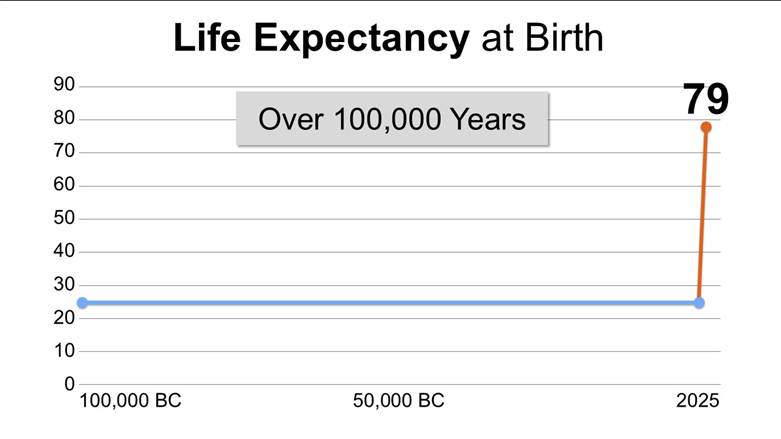
In the past century alone, the average life expectancy in the United States has jumped from age 47 to age 78 (Blakemore, 2019). So, everything in the fields of aging and longevity is a new frontier, demanding new, innovative thinking.
Evolving Stages of Life
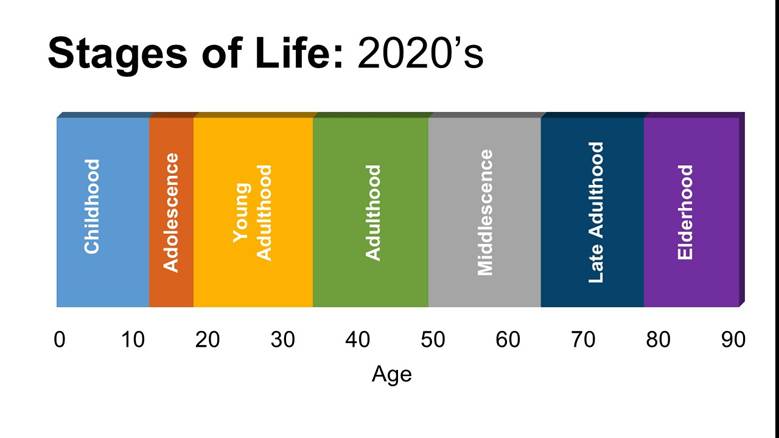
At the end of the 1800s, sociology recognized only three stages of life: childhood, adulthood, and old age (Neugarten, 1981). Then society began to shift its view of childhood and the role of education in upward mobility. The prevailing thought became that kids should go to school for a longer time before entering the workforce. Childhood took on a different purpose, and in 1904, G. Stanley Hall introduced a new stage of life called “adolescence” (Hall, 1904).
When Social Security was created during the Great Depression, policymakers chose age 65 as the marker of old age (Social Security Administration, n.d.). At that time, the average life expectancy was only 63 years (Tapia Granados & Diez Roux, 2009).
In the late 1940s, Baby Boomers burst onto the scene, destined to become the largest and most influential generation in American history. Boomers weren’t in a hurry to grow up—and many were born into enough affluence to have the time and means for extended education and a wide range of lifestyle explorations. A new life stage was coined by psychologist Erik Erickson in 1950, called “young adulthood,” generally thought to be between ages 18 and 34 (Erickson, 1950).
By the 1970s, for the Greatest and Silent Generations, retirement caught on as a time to rest and relax. As life expectancy continued to trend upwards, though, older adulthood changed again. People started going back to school, taking up new ideas, meeting younger friends, and relocating. If they had been divorced or widowed, some were falling in love again. In the 1970s and 1980s, another life stage found traction: “middlescence” (Kirwan, 2025). Situated approximately between ages 44 and 65, this phase is characterized by a need to rethink identity and find new challenges, new purpose, and deeper meaning in life’s second half.
In 1998, astronaut John Glenn returned to space at age 77. When I asked him if he was too old for the mission, he said, “Just because I’m 77 doesn’t mean I don’t still have dreams.”
As more of us are now living into our 80s and 90s and beyond, I propose a new, even more expanded map of the life course, where yesterday’s old age is replaced by dynamic and nuanced life stages—”middlescence,” “late adulthood,” and “elderhood”—that emphasize continued growth and purpose throughout our longer lives.
MATCH OUR HEALTHSPANS TO OUR LIFESPANS
In the ancient Greek fable, Eos, the beautiful goddess of the dawn, falls in love with the warrior Tithonus. Distraught over his mortality, she goes to Zeus’s chamber to request a special favor: She wants to love Tithonus until the end of time and begs Zeus to grant her lover immortality. “Are you certain that is what you want for him?” Zeus challenges. “Yes,” Eos responds.
As Eos leaves Zeus’s chamber, she realizes in shock that she forgot to ask that Tithonus also remain eternally young and healthy. With each passing year, she looks on with horror as he grows older and sicker. His skin withers and becomes cancerous. His organs rot and his brain grows feeble. As the decades pass, Tithonus’s aging body becomes increasingly frail, yet he cannot die. Ultimately, the once-proud warrior is reduced to a collection of pained, foul, and broken bones—but he continues to live forever.
Tithonus’s story is a fitting allegory for our healthcare system today. Until recently, most people died swiftly and relatively young of infectious diseases, accidents, or in childbirth. During the 20th century, however, healthcare breakthroughs eliminated many of those threats. The death rate from tuberculosis, one of the leading causes of premature death a century ago, has been nearly eliminated. Streptococcal infections have been transformed from killers into childhood annoyances. Pneumonia and influenza are no longer fatal by themselves. Whooping cough (Centers for Disease Control and Prevention [CDC], 2025b) and syphilis, once major epidemic diseases, now kill fewer than 1 in 200,000 people (Peterman & Kidd, 2019). Typhoid (Children’s Hospital of Philadelphia, 2026) and diphtheria (CDC, 2025a) no longer kill Americans at all.
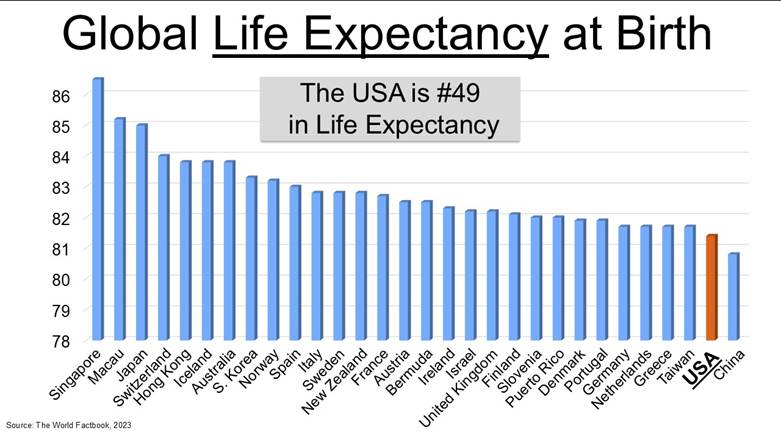
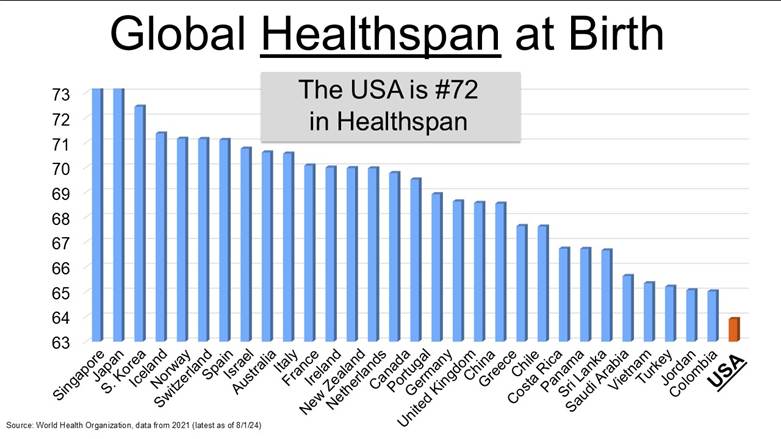
As a result of these advances, we are creating—for the first time in history—a mass population of long-lived people. But what kind of long life have we created? Though we’ve managed to prolong the lifespan, we have done far too little to prolong the healthspan. A century ago, the average adult spent only 1% of their life in a morbid or ill state; today’s average American adult will spend nearly 15% of their life sick (Garmany & Terzic, 2024), the preponderance of which is when they are older than age 65. The United States is number one in the world in health expenditure per capita (Wager et al., 2025) but where does all that expenditure leave us? At number 49 in global life expectancy (Parekh, 2025) and number 71 in healthspan (Utkus, 2025).
Yesterday’s healthcare system is badly outmatched with the demographically-driven problems of today and tomorrow. Additional funding alone will not solve the problems. Rather, by redirecting the priorities and resources of this system, we could produce much healthier elders and greater longevity—for less than we’re currently spending. To accomplish this, we must:
- Commit greater attention and resources to the scientific research required to cure, delay, or, if possible, eliminate the diseases of aging. Priority one: beat Alzheimer’s before it beats us. One in three people older than age 85 lives with Alzheimer’s or another form of dementia. And people with Alzheimer’s cost the system 5 times more than people without it (Alzheimer’s Association, 2025). Think of all the pain, suffering, and cost we could avoid if we demanded a cure and substantially increased the funding required to end this horrible disease.
- Provide academic training and continuing education to ensure that healthcare professionals are fully competent at meeting the needs of our older population. Our healthcare system wasn’t designed to promote and manage healthy aging, and Medicare reimburses physicians even if they haven’t received any training in geriatrics. According to the John A. Hartford Foundation (2024), 96% of American medical schools require a pediatric rotation while only 10% require a geriatric rotation. Further, recent John A. Hartford Foundation/Age Wave research tells us that a third of older adults see five or more doctors a year who usually don’t talk to each other (AgeWave et al., 2024). We need to demand more of medical schools, Medicare, and of our entire healthcare system so they become appropriately focused on the needs of our older population.
- Educate and motivate the entire population to take better care of themselves, their loved ones, and their communities. The United Sates trails the developed world when it comes to fostering lifelong wellness (Blumenthal et al., 2024). We must teach and promote healthier habits, with particular focus on healthy nutrition, daily exercise, sufficient rest, and proper use of medications. Aging starts from the time we’re born, so healthy aging lessons should be introduced in the earliest grades of school.
- Utilize next-level AI to help patients and health professionals navigate the complexities of mounting co-morbidities. Due to rapid advances in AI, we’re on track to transition swiftly to an era of “precision medicine” and scientific breakthroughs. These advances will permit a far deeper and richer understanding of the interactions between our genes, nutrients, molecular activity, and brain-body connection than ever before, allowing us to holistically track thousands of biomarkers. And if the AI is informed by a wide range of potential solution paths—allopathic, naturopathic, homeopathic, Ayurvedic, and others—it could be far more effective at precisely diagnosing what’s not working right and then proposing the ideal constellation of solutions for each individual (Orlov, 2026).
- Ensure universal healthcare for all. We are living longer lives than ever before, chronic diseases are the new pandemics (Terzic & Waldman, 2011), and age 65 is no longer a marker of anything. It’s time we learn from the best practices of other nations around the world and organize our healthcare system to meet the health and long-term care needs of everyone—not just the old, and not just the wealthy.
AVERT A NEW ERA OF MASS ELDER POVERTY
Retirees’ biggest financial worries are healthcare and long-term care expenses. Those fears are not unfounded, as the average couple that is age 65 today will spend $472,000 on out-of-pocket healthcare and long-term care (Age Wave et al., 2024). In this reality, better health is closely tied to lifelong financial security. In fact, there is intersectionality among all these variables, requiring experts in the field of aging to widen their lens.
While it’s true that poverty rates have gone down among older Americans, today, more than 60% of our population lives paycheck to paycheck (Picchi, 2023). With costs soaring for everything from a cup of coffee to college tuition, the future is uncertain, especially for women. Women are still paid about 82 cents on the dollar compared to men (Kochhar, 2023). If you roll that out over a lifetime, it’s a difference of approximately $498,000, with some variance by state. If we factor in lost wages and missed career opportunities due to breaks to provide childcare, and then down the road, eldercare, it’s a whopping difference of $1,300,000 over a woman’s lifetime (National Women’s Law Center, 2025).
Older women of color are hardest hit, with almost 30% of single Black women age 65+ and just over 40% of single Hispanic women age 65+ living in poverty (U.S. Census Bureau, 2024). We need to fix our financial discipline and social support systems so they better meet the demands of today’s demographic and economic realities.
Social Security is an essential lifeline for many older adults, but much has changed since it was established. The comparisons between 1940 and 2023 are eye-opening.
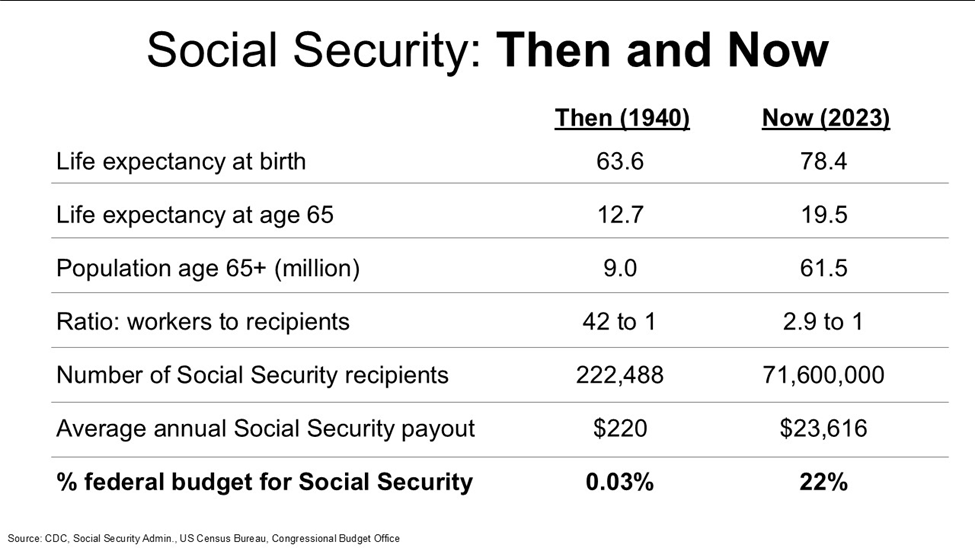
There were 42 workers supporting each recipient in 1945. Today we have only 2.9 workers for every recipient (Hurt, 2023). Young people today are supporting older people, and these young people are struggling. Their mental health is suffering, and their financial restraints prevent them from starting families and buying their own homes. This is not the fault of any individual. We’re simply living longer supported by systems not built for the replacement of a demographic pyramid with a demographic rectangle. To foster multigenerational equity, we must create systems-wide change that benefits every generation, at every life stage.
Politicians don’t like to talk about changes to Social Security, but as leaders in the aging field, we can advocate for and facilitate well-intentioned discussion. Potential changes that make sense to me include:
- Educate everyone—beginning in high school—about the fundamentals of lifelong financial planning and spending responsibly to allow our finances to last a lifetime.
- Incentivize people to work 5–10 years longer while gradually elevating the age of retirement to 70—or, if life expectancy continues to grow, to 75.
- Factor in home equity when determining an individual’s or couple’s wealth level. Income alone presents a false picture.
- Raise the cap on Social Security taxes so wealthy people would contribute far more to the system than they currently do.
- Put benefits through an affluence test so those in need receive more support and those who are well off receive less.
We should also educate Americans about course corrections they can make on an individual level to better afford their longer lives. As mentioned above, this includes working longer—maybe part-time, maybe for less money—but taking more time to build a nest egg. Downsizing is also a good option for many older adults, as is taking on housemates, Golden Girls–style. In the 1980s, Blanche, Dorothy, Sophia, and Rose showed us the beauty of interdependence—building community and financial security with less expensive lifestyle choices.
ELIMINATE AGEISM
It used to be “in” to be old. At the time of the signing of the U.S. Constitution, the average life expectancy was only 37, and the median age was a mere 16, mainly due to high infant mortality rates (Greene, 2015). Yet all those men at the signing had either powdered their hair or were wearing white wigs. Most were young, but they were certainly trying to look old, a custom of the time to indicate wisdom, power, and gravitas. Even Alexander Hamilton, seen below whispering into the ear of Benjamin Franklin, was only 30 at the time (Teaching American History, n.d.)! How did we get here—to an era in which ageism runs so deep?

At the beginning of the 20th century, the Industrial Revolution was creating a massive economic and sociological flip, and America began its obsession with youth. While on the farm, older men and women could continue contributing to some aspect of work or family life. In the factory, though, there was no sympathy for aging hands slowing down the assembly line. And because the industrial technologies were new, the wisdom of the old offered no useful advantage over the enthusiasm and raw strength of the young.
By the Roaring Twenties, youth was worshipped along with young attitudes, aspirations, and lifestyles. This youth obsession was turbocharged after the end of World War II, with the birth of the Boomers, the rise of middle-class affluence, and the emergence of modern media and marketing. During the Mad Men-esque heyday of the 1960s, young people represented the most potent growth sector. Boomers were teens and young adults, and tens of millions hadn’t yet decided what kind of shampoo, shoes, toothpaste, cars, or technology they preferred. Their loyalty was up for grabs.
Boomers are now older adults, but marketers remain fixated on youth. This shows up in the design of products we use every day and the images we’re bombarded with in all forms of media. It’s in the culture of organizations and job markets that assume youth outperforms age. In this new world, where people of all ages are continually trying new things, this makes no business sense. According to the Federal Reserve’s Survey of Consumer Finances, people older than age 50 now own 70% of all personal wealth held in the U.S. (Altus, 2023) and are actively involved in trying new things, exploring new possibilities, and even reinventing themselves. According to AARP, while people older than age 50 now represent the majority of consumer spending, they represent only 10% of the marketing dollars targeted to this audience (Daly Miller, 2015).
What can we do about it? We can start by exploring the new possibilities and purpose of maturity and longer life. In the early 1990s, when I asked feminist and adventurous aging pioneer Betty Friedan why she wrote The Fountain of Age (1993), she explained that we had come to a place in history where we were measuring everybody by the metric of youth. She said, “When you’re 50 or 60 or 70, you’re not going to be as quick or your body’s not going to be the same.” She then mused, “Maybe it’s time we began to measure the world not by the metric of youth, but by the metric of age and maturity: How thoughtful are you? How experienced are you? How wise are you? What are your new dreams?”
ACTIVATE A NEW PURPOSE FOR MATURITY
I recently gave a talk at an event in which the other featured speaker was octogenarian actor Harrison Ford. He’s a climate activist and gave a rousing speech about getting all the young people in the world to “plant trees and save the planet.” I had the fun and privilege of meeting him after his remarks. I fawned over his iconic movie roles, of course, but then asked, “Why only young people? There are a billion people in the world over the age of 60 and no one has tasked them with anything.”
It’s time to tap into what Marc Freedman, Founding CEO of Cogenerate.org, calls “arguably our only growing natural resource.” Freedman sees two problems. First, the message we’ve given older people, “Get out of the way, your best is behind you.” Second, he says, “The vehicles for older people who want to go in a direction of purpose and connection to get from aspiration to action are too few and far between.”
Yes, older adults need our help. But we need their help, too. Right now, the world feels rudderless and chaotic to many, especially younger people. Meanwhile, the average retiree spends more than 4 hours and 16 minutes a day on screens, whether it be the phone, TV or streaming services (Pew Research Center, 2019). By 2040, we will have 80 million Americans ages 60 or older and we’re not asking much of them (The Urban Institute, n.d.). It’s such a waste of purpose and possibility for every American, at every life stage.
I propose we use the community, networks, and infrastructure of the aging field to activate an Elder Corps. Just as Sargeant Shriver and John F. Kennedy launched a Peace Corps nearly 65 years ago (Peace Corps, n.d.), we can establish an Elder Corps to give a new purpose to maturity that allows adults to live every day with meaning and contribution, and to leave a legacy they value.
We can gather millions of older adults to use their time affluence—and their perspective, talent, and skills—to help families, schools, and young people understand that the future is going to be OK. By activating millions of elders to tutor children, mentor teens, teach classes on successful aging in high schools, provide job training to young adults, assist the homeless or others in need, or by helping other older adults and their caregivers, an Elder Corps could materially improve the lives of tens of millions of people in need. At this moment in time, the needs are vast, but so is the capacity of older adults to serve.
Can We Envision a New Age of Aging?
In the first chapter of James Michener’s captivating 1959 book Hawaii, he described how for millions of years, large tectonic plates were slowly moving and grinding against each other far below the sea that we now call the Pacific Ocean. As these forces converged, masses of land started to rise up from those plates and ultimately surfaced as beautiful Polynesia.
And so it is with the future of aging. For thousands of years, medical, economic, social, and demographic forces have been shifting and often grinding against each other. From this interplay new stages of life have been emerging and morphing.
As a result, for the first time in history, an extraordinary Age Wave is transforming every aspect of our lives. Birth rates continue to decline as longevity continues to rise. Our current systems are not prepared to meet the moment. But if we engage in the five course corrections outlined in this article, we can liberate a new age of aging—optimizing physical and mental health, enhancing lifelong well-being, and creating fresh sources of purpose and contribution. To accomplish this, we all must work together to:
- Uproot the ageism and gerontophobia that cloud our hopes for the future and replace them with a new, more positive image of aging as a time of perspective, contribution, wisdom and purpose.
- Discover, and make available to everyone, ways to grow old well, in the absence of debilitating illness, and especially the diseases of the aging brain such as Alzheimer’s.
- Replace the limiting confines of the linear life plan with a flexible, cyclic plan—with periods of education, work, and leisure throughout life—much more appropriate to the shifting needs of a longer life.
- Create a new spectrum of family relationships that are matched to the companionship, sexuality, friendship, and caregiving needs of older adults.
- Create products, services, housing, and programs that will treat older men and women with respect and provide comfort, convenience, pleasure, peak experiences, and purpose.
- Foster a new era of cooperation and interdependence among people of all ages, while creating a social system that is fair and equitable for everyone.
Who can do this? WE can!
We, who have spent our lives concerned for the well-being of older adults, now have an opportunity to collectively midwife an entirely new era of aging.
Ken Dychtwald, PhD, is a psychologist, gerontologist, and best-selling author of 19 books. He has served multiple times on the ASA board of directors and has twice been honored with the ASA Leadership Award. As Founding CEO of San Franciso area–based Age Wave, he has advised more than half of the Fortune 500 and numerous nonprofit associations and organizations.
Photo credit: Shutterstock/Chan2545
Age Wave, The John A. Hartford Foundation, & The Harris Poll. (2024). Meeting the growing demand for age-friendly care health care at the crossroads. https://www.johnahartford.org/images/uploads/resources/The_Growing_Demand_for_Age-Friendly_Care_Report_FINAL.pdf
Altus, K. (2023). Baby Boomers are becoming wealthier, while younger generations lag behind, fed report finds. FoxBusiness. https://www.foxbusiness.com/economy/baby-boomers-becoming-wealthier-younger-generations-lag-fed-report-finds
Alzheimer’s Association. (2025). 2025 Alzheimer’s Disease facts and figures. https://www.alz.org/getmedia/ef8f48f9-ad36-48ea-87f9-b74034635c1e/alzheimers-facts-and-figures.pdf
Blakemore, E. (2019, May 16). Life expectancy has increased in the past half-century, but so have health woes for the elderly. The Washington Post. https://www.washingtonpost.com/national/health-science/life-expectancy-has-increased-in-the-past-century-but-so-have-health-woes-for-the-elderly/2019/05/16/58833708-766a-11e9-bd25-c989555e7766_story.html
Blumenthal, D., Gumas, E. D., Shah, A., Gunja, M. Z., & Williams II, R. D. (2024). Mirror, mirror 2024: A portrait of the failing U.S. health system. The Commonwealth Fund. https://www.commonwealthfund.org/publications/fund-reports/2024/sep/mirror-mirror-2024
Centers for Disease Control and Prevention. (2025a). Diphtheria surveillance and trends. U.S. Department of Health and Human Services. https://www.cdc.gov/diphtheria/php/surveillance/index.html
Centers for Disease Control and Prevention. (2025b). Pertussis surveillance and trends. U.S. Department of Health and Human Services. https://www.cdc.gov/pertussis/php/surveillance/index.html
Children’s Hospital of Philadelphia. (2026). Diphtheria, tetanus and pertussis: The diseases & vaccines. https://www.chop.edu/vaccine-education-center/vaccine-details/diphtheria-tetanus-and-pertussis-vaccines
Daly Miller, S. (2015). 4 facts about the mighty 50+ demographic. AARP. https://advertise.aarp.org/50-insights/mighty-50-plus#
Erikson, E. H. (1950). The growth and crises of the healthy personality. In M. J. E. Senn (Ed.), Symposium on the Health Personality, Supplement II; Problems of Infancy and Childhood, Transitions of Fourth Conference. Josia Macy Jr. Foundation.
Garmany, A., & Terzic, A. (2024) Global healthspan-lifespan gaps among 183 World Health Organization member states. JAMA Network. https://jamanetwork.com/journals/jamanetworkopen/fullarticle/2827753
Greene, J. (2015). Revisiting the Constitution: We Need Term Limits for Federal Judges. The New York Times. https://www.nytimes.com/roomfordebate/2012/07/08/another-stab-at-the-us-constitution/revisiting-the-constitution-we-need-term-limits-for-federal-judges
Hall, S. (1904). Adolescence: its psychology and its relations to physiology, anthropology, sociology, sex, crime, religion and education. Appleton.
Hurt, W. (2023). How secure is Social Security? F&M Trust. https://fmtrustonline.com/money-moves-article/how-secure-is-social-security
The John A. Hartford Foundation. (2024). Warning from older adults: Care for aging in America needs urgent rethinking [Blog post]. https://www.johnahartford.org/newsroom/view/warning-from-older-adults-care-for-aging-in-america-needs-urgent-rethinking
Kirwan, J. (2025). Middlescence. Stanford Center on Longevity. https://longevity.stanford.edu/middlescence/
Kochhar, R. (2023). The enduring grip of the gender pay gap. Pew Research Center. https://www.pewresearch.org/social-trends/2023/03/01/the-enduring-grip-of-the-gender-pay-gap/
Livingston, G. (2019). Americans 60 and older are spending more time in front of their screens than a decade ago. Pew Research Center. https://www.pewresearch.org/short-reads/2019/06/18/americans-60-and-older-are-spending-more-time-in-front-of-their-screens-than-a-decade-ago/
National Women’s Law Center. (2025). The lifetime wage gap, state by state. https://nwlc.org/resource/the-lifetime-wage-gap-state-by-state/
Neugarten, B. L. (1981). Age distinctions and their social functions. Chicago-Kent Law Review, 57(4). https://scholarship.kentlaw.iit.edu/cklawreview/vol57/iss4/3/
Orlov, L. 2026. AI and Older Adults—What’s Now and Next in 2026. Aging and Health Technology Watch. https://www.ageinplacetech.com/page/whats-now-and-ahead-ai-and-older-adults-2026
Parekh, A. (2025). Make higher life expectancy the nation’s health priority. Bipartisan Policy Center. https://bipartisanpolicy.org/article/make-higher-life-expectancy-the-nations-health-priority/
Peace Corps. (n.d.) The founding moment. https://www.peacecorps.gov/about-the-agency/history/founding-moment/
Peterman, T. A. & Kidd, S. E. (2019). Trends in deaths due to syphilis, United States, 1968–2015. https://pmc.ncbi.nlm.nih.gov/articles/PMC6743072/
Picchi, A. (2023). More than 60% of Americans are living paycheck to paycheck. Here’s what researchers say is to blame. CBS News. https://www.cbsnews.com/news/paycheck-to-paycheck-6-in-10-americans-lendingclub/
Social Security Administration. (n.d.) Historical background and development of Social Security. https://www.ssa.gov/history/briefhistory3.html
Tapia Granados, J. A. and Diez Roux, A. V. (2009). Life and death during the Great Depression. PNAS. https://www.pnas.org/doi/10.1073/pnas.0904491106
Teaching American History. (n.d.) The age of the delegates in 1787. https://teachingamericanhistory.org/resource/the-constitutional-convention/delegates/age/
Terzic, A. & Waldman, S. (2011). Chronic diseases: The emerging pandemic. Clinical and Translational Science, 4(3), 225–226. https://doi.org/10.1111/j.1752-8062.2011.00295.x
The Urban Institute. (n.d.). The US population is aging. https://www.urban.org/policy-centers/cross-center-initiatives/program-retirement-policy/projects/data-warehouse/what-future-holds/us-population-aging
U.S. Census Bureau. (2024). Income & poverty data tables. U.S. Department of Commerce. https://www.census.gov/topics/income-poverty/data/tables.html?text-list-39f15fd892%3Atab=2025#text-list-39f15fd892
Utkus, S. (2025). High time to prioritize healthspan. Pension Research Council. http://pensionresearchcouncil.wharton.upenn.edu/blog/high-time-to-prioritize-healthspan/#:~:text=Source:%20U.N.,policymakers%20might%20take%20to%20help
Wager, E., McGough, M., Rakshit, S., and Cox, C. (2025). How does health spending in the U.S. compare to other countries? Peterson-KFF Health System Tracker. https://www.healthsystemtracker.org/chart-collection/health-spending-u-s-compare-countries/