

Abstract:
Aging populations are generally seen as an economic threat. We argue the opposite—a well-managed longevity economy, anchored by the ages-50-and-older cohort’s $45 trillion contribution to global GDP, represents one of the most significant growth opportunities of the 21st century. Realizing that opportunity requires shifting from fragmented, siloed policy responses toward a systems-oriented approach that aligns capital, policy, and innovation across sectors. This includes a coordinated three-pillar framework: research-driven innovation powered by responsible AI; rapid prototype testing and evidence-based scale-up of new care and workforce models; and field-building to align policy, investment, and cultural narratives around productive aging. This approach treats longevity as a systems-level transition, requiring portfolio-based investment strategies, shared infrastructure, and mechanisms to capture value across layers of economic and social return. Intergenerational equity, not burden-shifting, is the animating principle throughout.
Key Words:
longevity economy, productive aging, ageism, AI-enabled innovation, intergenerational policy, workforce participation, aging in place, field-building
Much of the world has entered a new phase of demographic development in which people are living longer and healthier lives. A throughline of the 21st century—population longevity—must co-exist with continued improvements in economic stability across multiple generations, and a stronger focus on sustainability. If we array our policy and economic investments strategically, the economic contributions by older adults across longer, healthier lifetimes can benefit the economy, civil society, and communities.
This implies not just more investment, but different investment logic. Longevity is not a single-sector opportunity. It is a system-level transition requiring coordinated action across health, housing, labor markets, and community infrastructure. Traditional project-based funding models are poorly suited to this task. This article presents a multipronged strategy designed to meet this goal.
Already, the economic contributions of older adults are significant. Recent data show nearly 20% of Americans who were age 65 in 2023 were employed, according to the Pew Research Center (Fry & Braga, 2023). Of those, 62% were working full-time. This is twice the number in that age bracket who were working in 1987, when most were employed in part-time jobs.
Estimates by AARP in its Longevity Outlook series calculated the economic contributions of Americans ages 50 and older in 2018 at more than $9 trillion, projected to keep rising through 2050 (Fry & Braga, 2023). AARP’s broader “Global Longevity Economy Outlook” (AARP, n.d.) concluded that the ages50 and older population contributed $45 trillion in 2020 to global Gross Domestic Product, accounting for 34% of total global GDP. The chart from this report below illustrates the scale of older adults’ economic contributions.
Figure 1: Older Adults’ Economic Contributions
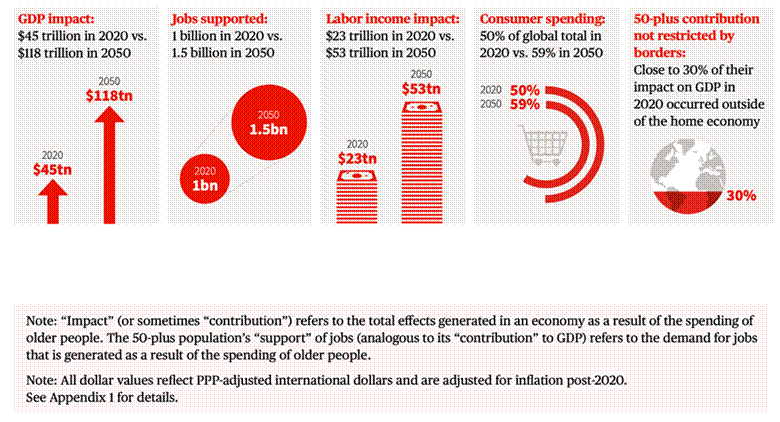
(From AARP, n.d.)
The necessity of rapid social and economic adaptation is illustrated in the graph below, which shows there will be no growth in the number of children between now and 2040.Given that the number of people ages 50 and older across the globe began in 2023 to surpass the number of children younger than age 15, optimizing our longevity economy now needs to be a key cross-cutting goal for policymakers and stakeholders. We have a timely opportunity to focus on how to adapt society—including cultural attitudes toward aging, how we think about the nature of work, and the ever-larger role that technology will play in enabling efficiencies and powering productive longevity. We can adapt and thrive by investing in actions to lengthen the typical healthy, productive life of many older adults, and by designing solutions for a workforce that explicitly includes tens of millions of mature workers as well as younger adults.
Figure 2: Children (0–14) Versus Older Adults (ages 50 and older)
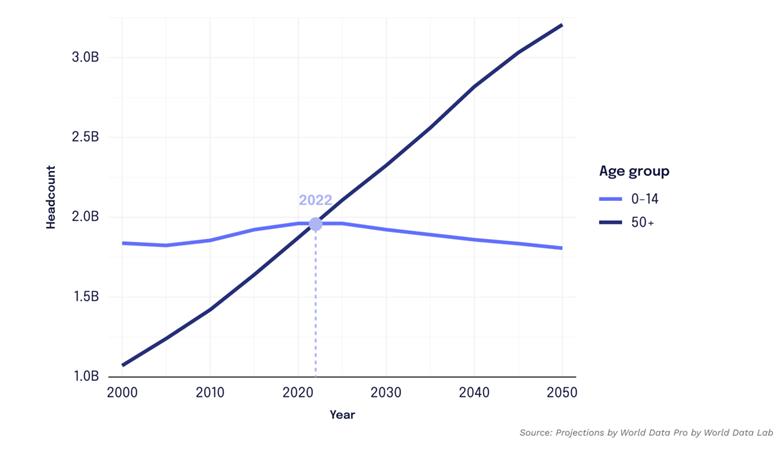
(From Fengler, Caballero, & Iyengar, 2024)
One cultural challenge to advancing and realizing benefits from a longevity economy is ageism. Defined as prejudice or discrimination on the basis of chronological age, ageism exacts an economic toll on individuals and society, while exacerbating other forms of disadvantage.It is also associated with poorer physical well-being, poorer mental health, and acts as a significant barrier that limits the economic potential of older adults, creates substantial financial burdens on society, and curtails the overall growth of the longevity economy (Claude Pepper Center, 2018). For these and other reasons, dismantling ageism is considered a key priority for shifting the narrative of an aging population from being a “burden” to being a “driver of economic growth” (European Commission Joint Research Centre, 2024).
While there is a widespread belief that economic growth will plummet as societies age, we may in fact be able to mitigate that effect by implementing policies that engage more older adults in the workforce. In an article published in The Lancet in 2021, Scott (2021) observed that “the ultimate drivers of economic growth are investment in physical capital (e.g., buildings, plant, and machinery), employment, human capital (e.g., education and skills), productivity (output per worker), and innovation.” Therefore, a key goal for optimizing a longevity economy is to encourage and enable (but not mandate) what Scott called “employment over the life course” rather than a traditional career followed by retirement. This shift requires boosting human capital and productivity, as more older workers seek to maintain their skills for longer, and significant investment in innovation.
We can adapt and thrive by designing solutions for a workforce that explicitly includes tens of millions of mature workers as well as younger adults.
What is required is a shift from fragmented programmatic funding toward system investing—an approach that strengthens the underlying conditions for entire ecosystems to function, rather than financing isolated solutions.
To optimize intergenerational policy investments and maximize the economic upsides of a longevity economy organized around a life-course perspective, we need policies that stress innovation and are intergenerationally fair. For our long-lived population, we recommend a systemic, cross-cutting framework organized around three core pillars: research-driven innovation, prototype implementation, and field-building and narrative change.
Pillar 1: Research-Driven Innovation
We have the power to transform longevity through the responsible implementation of AI tools. Research data, when powered by responsible AI, is the cornerstone of creating efficiencies that extend productive careers and deliver personalized, preventive, and predictive care—all while increasing affordability and accessibility (Marino et al., 2023).
Doing so will require close attention to data best practices and ethical frameworks. To contribute to the creation of a longevity economy, responsible research-driven innovation must establish foundational systems to capture, analyze, and disseminate best practices in aging services, preventive care, and community support. It is critically important that these systems are effective across diverse populations and settings, to reflect what we know about the broad range of lifestyles and contexts our older population inhabits.
When used responsibly, AI has the potential to facilitate a level of individualized care and prediction that we have not yet achieved in healthcare. AI will have the ability to predict health trajectories, personalize interventions, and optimize care pathways based upon individual biological, behavioral, and social determinants of aging. And, key to its importance, AI will be able to do so effectively at a scale and pace that can match the growth of the aging population.
Any ability or intent to harness the powerful benefits of AI must be predicated on a firm grounding in ethical frameworks and secure systems. These factors are not an afterthought in this process; they must comprise the solid foundation upon which innovation and implementation rest. Research-driven innovation of the sort needed to pivot our economy effectively into the future must be driven by secure, interoperable data systems with robust ethical guidelines that enable this innovation while ensuring privacy and equity for all constituents.
These systems should be understood as shared infrastructure for the longevity economy—enabling distributed actors to contribute, learn, and coordinate. Without this layer of system infrastructure, innovation remains localized and non-transferable across contexts.
Pillar 2: Prototype Implementation
Building upon responsible AI, we can accelerate the longevity economy by testing new ideas quickly and scaling what works. The approach has two sequential stages: rapid innovation testbeds, followed by evidence-based scale-ups.
The first stage creates low-cost environments for testing AI-enabled interventions prior to broader commitment. Innovation testing hubs can prototype services with diverse older adult populations against agreed-upon performance metrics. Residential “smart-home microlabs” can pilot AI and IoT (Internet of Things) integrations focused on prevention and health maintenance. Where physical pilots are premature, digital-twin simulations allow virtual testing first. Workforce mini-pilots using hybrid human-AI care models can measure impacts on care quality and staff experience before any intervention goes to scale.
Once validated, interventions should expand strategically—into Opportunity Zone neighborhoods and aging-in-place communities, using existing tax credit structures and financial incentives. Scale-up works best when it coordinates across healthcare, housing, and social services simultaneously, builds in workforce training, and links longevity innovations explicitly to local job creation.
Rather than treating these efforts as isolated pilots, they should be structured as coordinated portfolios—where multiple interventions across settings reinforce one another and generate compounding system-level effects. This portfolio approach allows learning, capital, and outcomes to align across actors, accelerating the transition from experimentation to systemic change.
Real-world examples show this is achievable. The Thome Rivertown Neighborhood Project in Detroit anchored longevity-focused development in a disinvested area, spurring affordable housing construction, rehabilitation of existing buildings, and recruitment of long-term services and supports providers.
‘AI has the potential to facilitate a level of individualized care and prediction that we have not yet achieved in healthcare.’
These models demonstrate the potential for single investments to generate multiple layers of value—from direct economic returns to broader spillover effects such as community revitalization, workforce participation, and reduced healthcare costs. Recognizing and structuring these multi-layered returns is essential to attracting sustained investment into the longevity economy.
Presbyterian Villages of Michigan is now using those lessons to develop a replicable “Connected Communities” framework. The Tri-Valley Case Management Accelerated Training program demonstrates what cross-sector workforce collaboration can achieve at scale. On the digital side, GetSetUp—a peer-led platform designed specifically for older adults—offers skills and career training to more than a million members globally. The Center for Workforce Inclusion, the only national organization dedicated exclusively to older workers, launched a 2024 partnership with Coursera to deliver curated digital and job-readiness courses to older job seekers nationwide. The bottleneck is not a shortage of good ideas—it is the absence of a disciplined methodology for testing, evaluating, and scaling them.
Pillar 3: Field-Building and Narrative Change
Finally, a thriving longevity economy requires more than technological innovation—it demands coordinated policy frameworks, strategic investments, and new cultural narratives about aging. This pillar examines how to build the field through an intergenerational lens that extends productive years and improves quality of life.
A thriving longevity economy also requires new forms of system financing—mechanisms that enable multiple stakeholders to co-invest in shared outcomes, including pooled funds, outcome-based contracts, and blended capital structures. These approaches allow value created at the system level to be recognized and reinvested.
We must create policy frameworks that ensure economic security through strengthened workforce participation and financial stability across the lifespan. The United States does not yet have an activist, pro–older workers system in the form of incentives for phased retirement or for healthcare coverage (e.g., by ensuring that every American has excellent health insurance regardless of age) the effect of which would be to reduce employer costs for hiring older workers.
By offering transitional jobs to unemployed and underemployed adults, paying all workers at least a decent minimum wage, enhancing tax credits (EITC and CTC) without marriage penalties, and ensuring adequate Social Security benefits above poverty lines, we can create the work-based economic security needed for a longevity economy. A recent report (Werner & Giannarelli, 2025) by the Urban Institute confirms that such a “policy package” would greatly increase employment and earnings, dramatically reduce poverty, and produce a huge expansion of the middle class for all age groups.
These policies would support and incentivize savings and asset-building, allowing workers to build resources for later life, and providing leeway to explore re-skilling and new educational and employment possibilities. Safety net reform—especially restructuring disability benefits (SSI/SSDI), would create clear pathways back to employment, and a policy-driven expansion of resources for childcare and family caregiver support would allow more older adults to participate in the workforce.
In addition to developing these crucial policy frameworks to formalize our commitment to a longevity economy, we must support implementation research and foster innovation enablers like regulatory flexibility, cross-sector integration, community resource development, and digital safety. Regulatory flexibility could look to innovation authorities (e.g., waivers provided through the Center for Medicare and Medicaid Innovation) to build out person-directed living models for older adults and individuals with disabilities. This could be achieved through incentivizing communities to collaborate with lenders, investors, PACE programs, housing projects, workforce experts, and various healthcare and supportive-service providers to develop continuum-of-care initiatives. Community planning grants could incentivize coordination among multiple organizations to improve access to nutritious food, green spaces, and accessible transportation. These initiatives must be pursued with a deep commitment to cross-sector integration to ensure that aging considerations and “health in all policies” analysis are factored into transportation, housing, education, and other services, and to the assurance of digital safety to protect older adults from online scams and fraud.
Of all the solutions put forth thus far, changing the narrative around aging to mitigate ageism may be the most challenging. Shifting cultural mindsets about aging and longevity will need to be tackled on multiple fronts. For example, public education programming that features tailored content about the benefits of the longevity economy can be encouraged, and public awareness campaignscan highlight older adults’ economic contributions, community participation, and opportunities for intergenerational collaboration. Age-friendly forums that engage older adults and neighbors of all ages to co-design adaptations to population longevity can be held.And free, online educational resources can be disseminated to encourage employers to support older workers in career transitions and skill enhancement. These can be implemented in partnership with motivated employers who are committed to investing in an organizational culture that promotes community-connected living.
The systems-based framework described here leverages the technological advances unleashed by AI and harnesses the power of data infrastructure for improving policy frameworks that take population longevity and productivity into account. Such an approach stands to make substantial improvements in quality of life and would also enable us tomeasure the economic value of gains arising from health improvements. As noted by Scott (2021), “past public health initiatives achieved widespread reductions in health inequalities in childhood and middle age; now the same thing needs to happen in older years.”
A thriving longevity economy demands coordinated policy frameworks, strategic investments, and new cultural narratives about aging.
There is no single solution, or response, to the demographic shifts and associated challenges we are seeing. Rather, a series of adaptations are needed to address socioeconomic, gender, race, family structure, spending patterns, and cultural factors. The most successful responses will prioritize flexibility for adjusting to local circumstances and larger societal changes, as well as continuous improvement—not designed in isolation and rigidly implemented from the top down.
We view population longevity, and our now-booming longevity economy, asa great opportunity for every generation to seek improvements in life—not just older persons. We recognize that the intergenerational shifts becoming more prominent in policy and political discussions can be perceived as a net-negative or a net-positive for society—depending upon how they are framed and implemented in local aging ecosystems.
The opportunity is not simply to respond to demographic change, but to redesign the systems through which value is created and shared across generations. Longevity, properly understood, is a systems challenge—and therefore requires systems-level responses in investment, governance, and infrastructure.
Those who succeed will not be those who build the best individual programs, but those who orchestrate the most effective ecosystems.
Anne Montgomery, MS, is an experienced policy analyst and health systems researcher specializing in long-term care and support systems for older adults and individuals living with disabilities. An independent consultant working with the National Committee to Preserve Social Security and Medicare, AgingIN, the Live Oak Project, and Gray Panthers NYC, Montgomery served the U.S. Congress for a decade, developing legislative policy for the Senate Special Committee on Aging and the House Ways & Means Committee. She also served as Altarum’s director of the Center for Eldercare and Advanced Illness.
Joe Angelelli, PhD, is the CEO of Lifespan, Inc., in Homestead, PA, and serves on ASA’s Generations Journal Editorial Advisory Board. Lifespan is a nonprofit agency providing critical support and services for residents ages 60 and older in Allegheny County, Penn. Angelelli has more than 25 years of experience in thought leadership, systems transformation, and community partnerships.
Stephen Johnston has a lifelong interest in healthy longevity. He serves as managing director of Fordcastle, an innovation advisory and venture studio, and co-founder of Aging2.0 and the Chorus Project. He curates the Looking Forward newsletter and is coauthor of Longevity Hubs (MIT, 2024) and Growth Champions (Wiley, 2012).
David Riemer is a senior fellow at the Community Advocates Public Policy Institute. He has written extensively on topics including U.S. poverty and the policies to alleviate it and has worked on Capitol Hill and as budget director for the state of Wisconsin.
Photo credit: Shutterstock/David Gyung
References
AARP. (n.d.) Global longevity economy outlook: The economic contribution of people age 50 and older. https://www.aarp.org/content/dam/aarp/research/surveys_statistics/econ/2022/global-longevity-economy-report.doi.10.26419-2Fint.00052.001.pdf
Claude Pepper Center. (2018). Longevity economics: Leveraging the advantages of an aging society. https://claudepeppercenter.fsu.edu/longevity-economics-leveraging-the-advantages-of-an-aging-society/#:~:text=An%20aging%20society%20is%20a,change%20in%20the%20Longevity%20Economy
European Commission Joint Research Centre. (2024). Addressing ageism: a key priority for a society of longevity. https://joint-research-centre.ec.europa.eu/jrc-news-and-updates/addressing-ageism-key-priority-society-longevity-2024-07-11_en#:~:text=In%20the%20labour%20market%2C%20ageism,Ageism%20in%20the%20media
Fengler, W., Caballero, & Iyengar, V. The age of the longevity economy. Brookings. https://www.brookings.edu/articles/the-age-of-the-longevity-economy/#:~:text=Yet%2C%20the%20milestone%20with%20perhaps,fanfare%3A%20The%20number%20of%20older
Fry, R., & Braga, D. (2023). Older workers are growing in number and earning higher wages. Pew Research Center. https://www.pewresearch.org/social-trends/2023/12/14/older-workers-are-growing-in-number-and-earning-higher-wages/
Marino, N., Putignano, G, Cappilli, S., Chersoni, E., Santuccione, A., Calabrese, G., Bischof, E., Vanhaelen, Q., Zhavornkov, A., Scarano, B., Mazzotta, A. D., & Santus, E. (2023). Towards AI-driven longevity research: An overview. National Library of Medicine. https://pmc.ncbi.nlm.nih.gov/articles/PMC10018490/#:~:text=Abstract,major%20ally%20of%20aging%20research
Scott, A. (2021). The longevity society. The Lancet, 2(12), E820–E827. https://www.thelancet.com/journals/lanhl/article/PIIS2666-7568(21)00247-6/fulltext
Werner, K. & Giannarelli, L. (2025). How a work-based policy package can reduce US poverty. The Urban Institute. https://www.urban.org/sites/default/files/2025-08/How%20a%20Work-Based%20Policy%20Package%20Can%20Reduce%20US%20Poverty.pdf