
My mother had a system.
Every morning, she would retrieve the newspaper from the porch, take a pair of scissors and cut out the small section at the top that contained the date. Then she would put it in her left pocket. It took me years to understand what she was doing.
My mother had dementia, although for a long time I didn’t know it. We had always been very close. I lived around the corner from her, but gradually there was a distancing between us. She became more guarded about what she shared with me and seemed to want to spend less time together.
At the time, I worked full time in healthcare, had a young son and a busy life. I noticed individual moments, but I didn’t recognize the pattern. Looking back, I do.
She began to distance herself, not because she didn’t love or trust me, but because I might recognize what was happening and interfere with the independence she was trying to preserve. Was it that she was just trying to hide her memory loss? Now I understand that it was much more. She was adapting, creating systems that let her keep being herself.
The date in her pocket was one of them. My mother had always been a calendar person. Eventually, calendars stopped being useful. If you don’t know what day it is, future dates don’t necessarily orient you. So she invented something simpler: one date. Today.
She developed other systems, too. Before doctor’s appointments, she figured out the questions used to evaluate her memory, wrote down the answers and studied them. She could pass the test. When company visited, she kept conversational crib notes. A newspaper clipping about the Yankees could help her join a conversation she otherwise couldn’t follow.
She began to distance herself, not because she didn’t love or trust me, but because I might recognize what was happening and interfere with the independence she was trying to preserve.
For a long time, I thought she was gaming the system. Now I think: Of course she was. She was fighting for herself. Those scraps of information gave her something dementia was slowly taking away: agency.
The Essence of Who I Am
I’m closer now to the age my mother was when some of this began, and I understand her differently. I also have something she didn’t have: artificial intelligence.
I hear people describe AI as a “second brain.” I’m interested in something more personal. What if I intentionally began capturing the essence of who I am? Not just photographs, dates and documents. My stories, humor, values, quirks, what makes me feel safe and powerful, and what matters to me.
Consider my medical record. It records my weight. Clinically, that’s useful. But if someone someday needs to understand me, I would rather they know how much clothing means to me. I love clothes: women’s clothes, men’s clothes, different sizes and shapes. I love fabric, texture and unexpected combinations. Clothing is creative for me. I use it to express, and sometimes change, how I feel. My appearance gives me agency over how I enter the world.
If I’m someday unable to explain that, does it stop mattering? I don’t think so.
My medical record also contains my age. But that number says little about my relationship with aging. I returned to school at 56 and went skydiving for the first time at 57. If I reach 84, don’t let the number decide who I am. Ask me what I want to learn next.
These are the things I want preserved, not because they’re medically important, but because they’re important to me. And perhaps AI gives us a new way to do that.
Imagine something more alive than a digital scrapbook: AI grounded in the words and stories I chose to preserve, capable of helping me engage with my own history. A bridge back to myself.
A Photograph and a Way Back
I’ve already seen how important that bridge can be.
After my father died, there came a day when my mother realized again that her husband was gone. She was furious that no one had told her. To her, it was new information, and nothing I said helped. Then I remembered a digital photograph on my phone of my mother standing in front of my father’s grave. I hesitated. I didn’t want to prove her wrong or correct her memory. I wanted to help her find her footing.
I showed it to her. She could see herself there. She had known. She had been there. She had said goodbye. Her anger softened.
The photograph didn’t restore her memory. It gave her context, restored trust between us and created a bridge to the life she had actually lived. Maybe that’s what I’m interested in building.
My mother used to tell me, “They can take everything away from you, but they can’t take your memories.” There is a bitter irony in remembering those words now. Dementia did take many of her memories.
Leaving My Own Breadcrumbs
My mother used newspaper clippings, calendars, photographs and handwritten notes. What could I create with the tools available to me? There are important questions. Who owns this information? Who controls it? How do we distinguish my words from what AI generates? How do we keep a tool meant to preserve autonomy from taking autonomy away?
I’m curious enough to start asking.
My mother used to tell me, “They can take everything away from you, but they can’t take your memories.” There is a bitter irony in remembering those words now. Dementia did take many of her memories. But it never completely took her. Her strong will, humor and determination to stay one step ahead remained. The woman cutting the date from the newspaper was improvising.
Maybe preserving ourselves doesn’t mean creating a perfect digital copy or defeating dementia. Maybe we leave ourselves breadcrumbs. A story. A voice. A photograph. A preference. A memory. An explanation of why something matters. Enough pieces that, if we someday lose the path, something might help us find our way back.
My husband recently listened to me talk about all of this and said, “Maybe you should be the one to start.”
So here I am. Starting.
I don’t know whether I will ever need the digital equivalent of the date my mother carried in her left pocket. But I can begin creating it while I still get to decide what goes inside. I like knowing that I have options.
Lori Vernachio is an experienced senior living executive, social worker, graduate of Rosemont College, and doctoral candidate in Whole Health Leadership at Southern California University of Health Sciences. Through her capstone, she explores how technology can support identity, autonomy, and what matters most as we age.
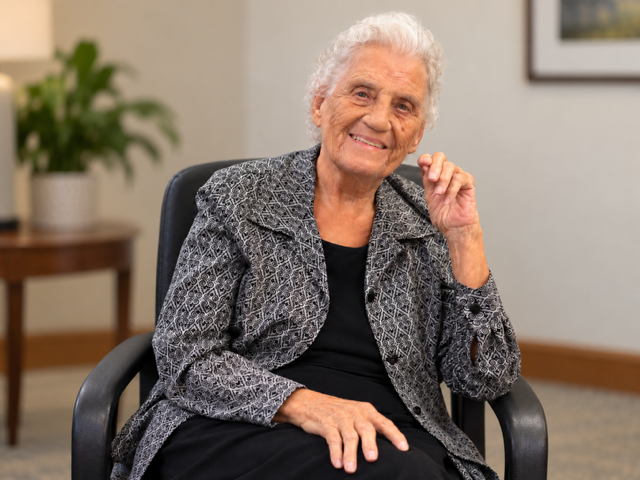
Photo credit: Alice Vernachio courtesy of Lori Vernachio
AI Use Disclosure: All ideas, personal experiences, reflections, and perspectives in this article are original to Lori Vernachio. Artificial intelligence was used as a writing support tool to help organize ideas, refine wording, and edit for clarity and flow. The author directed, reviewed, and approved the final content.