
Editor’s note: This Q&A features thoughts from Tanya Alteras and Kalpana Ramiah of JAHF grantee America’s Essential Hospitals, an association representing more than 400 hospitals committed to providing high-quality care for all, including people who face social and financial barriers to care.
How are essential hospitals working to meet the health needs of community members as they age?
Tanya: Our member hospitals care for communities from birth to end of life; right now we are seeing an uptick in poverty rates among people age 65 and older. These are potentially individuals who have gone for decades with unmet or delayed health care needs and experienced long-term challenges related to social determinants of health.
Some of our hospitals are looking at patients and members of the community before they reach the age we define as older adulthood—age 65. They are trying to reach people in their 50s and think through what they need to stay mobile, remain independent as they age, and enter the 65-and-older stage of life healthier.
All of the 4Ms of age-friendly care (evidence-based health care practices focused on What Matters to the patient, Medication, Mentation and Mobility) play into what our hospitals are trying to do well before people reach age 65, including supporting mobility, helping people build networks to prevent isolation, and addressing depression and behavioral health as part of mentation.
How are AEH members approaching implementation of the 4Ms Framework, and what considerations are emerging in essential hospital settings?
Tanya: A cohort of AEH members is currently participating in the Institute for Healthcare Improvement’s Age-Friendly Health Systems Action Community and is in the learning, thinking, and designing phase. We have also reached out to members that have completed the Action Community, and have received level 1 or level 2 recognition, to provide teaching and mentorship.
For essential hospitals with limited human or financial resources, establishing the infrastructure and adopting new workflows needed to operationalize the 4Ms is a challenge.
On the face of it, the 4Ms are thoughtfully designed, straightforward, and written very clearly. Getting buy-in is in some ways the easy part; there is significant recognition that the 4Ms are critically important. But translating them into EHR workflows, creating infrastructure (data and otherwise) to support adoption, and moving beyond assessment to actionable processes is complicated. For essential hospitals with limited human or financial resources, establishing the infrastructure and adopting new workflows needed to operationalize the 4Ms is a challenge.
Kalpana: Our research and innovation team works with members on many topic areas, so they understand—and we understand—the challenges as well as the opportunities around implementation and adoption.
For example, Essential Hospitals Institute is in the process of developing a learning collaborative focused on improving cardiac rehab rates for older adults. We can connect that with many of the things we are doing. The 4Ms learning collaborative does not have to stand alone; integration can happen across other topical areas.
What have you learned from essential hospitals that are further along in implementing age-friendly care?
Tanya: It’s been fascinating to see the different strategies they are using to roll out age-friendly care in particular clinical areas. They might start in med-surg or the emergency department, learn from that process and then apply what they have learned in another department. Each department has a different workflow, which is part of the challenge. With every new cycle of adoption, they understand more about how to improve their implementation of the 4Ms.
Peer learning is a big part of AEH’s work. What do essential hospitals gain from learning together as they implement the 4Ms Framework?
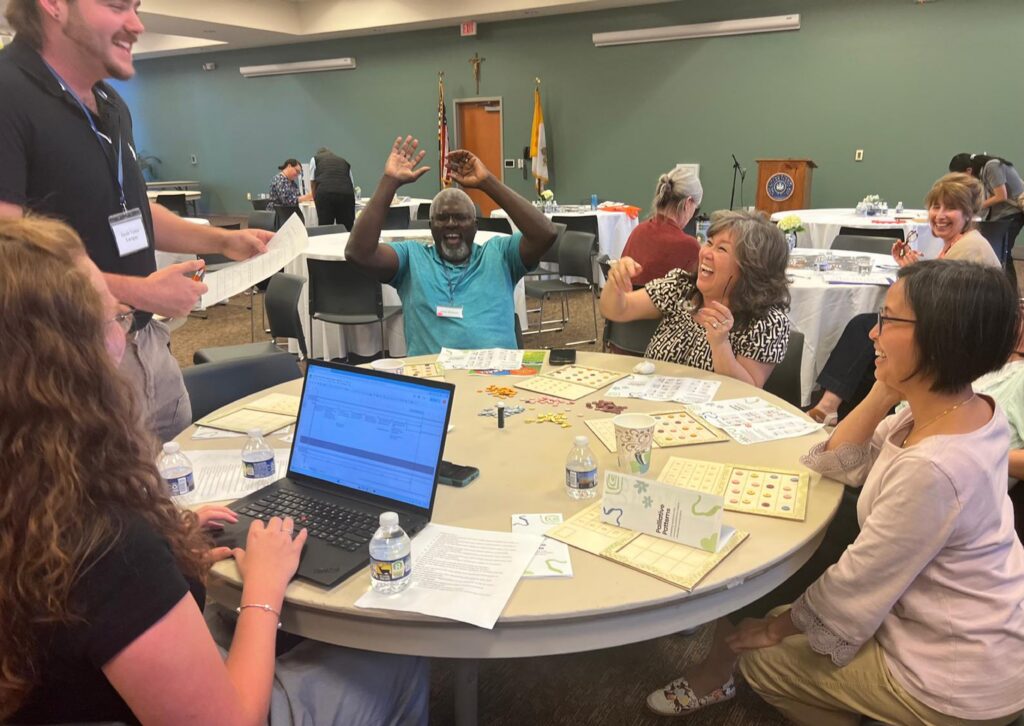
Tanya: Everything they are learning and all the resources they are receiving through the IHI Action Community have been tremendous. Our specific AEH cohort has become almost like a support group because the participants understand each other. They are all essential hospitals, so they do not have to explain to each other their funding constraints, or their specific difficulties. It’s a safe space where they can talk freely and get practical advice from others operating under very similar constraints.
There’s always great discussion during the meetings. A big goal of these efforts is to create peer-to-peer networking opportunities. So we love when participants ask whether they can follow up with a speaker afterward because they have additional questions. They now have someone they can talk to, and those connections are incredibly valuable.
What role can partnerships between hospitals and community-based organizations play in advancing more equitable care for older adults?
Tanya: Essential hospitals work hand in hand with a diverse mix of community organizations, including secular service organizations and religious organizations. We focus on ways in which essential hospitals are developing strong, trust-based partnerships to support patients in accessing non-clinical services, such as housing and transportation, as well as helping address mental health and preventive and primary care.
Through these partnerships, our hospitals are connecting older adults to support services. What we are finding is that there is a lot of opportunity for alignment between how hospitals help patients access services to meet social drivers of health, and how they use the 4Ms to identify other services older adults might need, including support that addresses isolation.
We are helping future leaders think about how to use the platforms, infrastructure, and resources being created now to meet the needs they will encounter 10 years from now.
How can leaders of essential hospitals continue to advance high-quality, equitable care for older adults?
Tanya: We see leaders at essential hospitals as working hand in hand with front-line clinical and operations staff to understand the roadblocks getting in the way of staff being able to provide the highest quality care to patients. These roadblocks may include training, a lack of clearly defined scope for a new initiative, or need for additional resources.
It’s also important not to view older adult patients in a silo. Challenges involving care coordination and post-acute care apply to the entire system and every patient. Older adults who cannot be discharged because they do not have a safe place to go are already being affected by issues involving post-acute care, discharge, and emergency department boarding, creating challenges for essential hospitals. Care for older adults is woven into the broader picture, including care coordination, housing, transportation, behavioral health, and support networks.
Kalpana: In our leadership development programs, we think of participants as future leaders who are not only going to shape the work in a health system but are also thought leaders and active participants in communities’ health. One of the biggest challenges they will face is creating a systemic approach to caring for a much larger population of older adults, including people who might need care at home. We are helping future leaders think about how to use the platforms, infrastructure, and resources being created now to meet the needs they will encounter 10 years from now.
Tanya Alteras, MPP, is director of research and innovation at America’s Essential Hospitals. Her work has focused on health care delivery and payment reform, health care financing, and expanding access to care.
Kalpana Ramiah, DrPH, MSc, is vice president of innovation at America’s Essential Hospitals and director of the Essential Hospitals Institute, the association’s research, education, and leadership development arm.
Photo credit: Shutterstock/Art_Photo