

Abstract
As Americans live longer, healthier lives, aging policy is at a crossroads. Multisector Plans on Aging (MPAs) have begun transforming how states address caregiving, health, and housing, but they largely overlook a critical component of well-being: work. Integrating the age 50+ workforce into these plans remains an important policy gap and an economic and social opportunity. By recognizing older adults may be recipients of services as well as contributors, states can boost economic growth, strengthen financial security, and redefine aging as a time of purpose, productivity, and possibility.
Key Words
Multisector Plans on Aging, MPA, National Plan on Aging, 50+ workforce, older workers, age-inclusive workforce, economic opportunity, workforce participation, aging policy and longevity economy
Since 1965, state aging policies have been directed through the Older Americans Act (OAA), which is managed by the Administration of Community Living (Colello & Napili, 2024). Each state established units on aging and area agencies on aging, charged with creating strategic plans. These strategies focus on supporting adults age 60 and older with the greatest economic and social needs. Services include access to nutrition programs, caregiver support, older adult rights, health promotion, and transportation.
Today across America, states are re-evaluating how to better support an aging population. Multisector Plans on Aging (MPAs) have emerged as a new framework that blends health, housing, transportation, and support services into multi-layered strategies that extend beyond the traditional OAA ecosystem and priorities (West Health, 2024).
MPAs do a good job of addressing care and support needs, but for the most part, overlook a critical dimension of aging, continued economic participation.
The development of MPAs marks progress but they remain incomplete. MPAs do a good job of addressing care and support needs, but for the most part, overlook a critical dimension of aging, continued economic participation. As the development of MPAs grows and the lens broadens, an important opportunity becomes apparent. How do plans fully integrate work and economic prosperity for older adults into the MPA framework?
If MPAs are designed to prepare states to assist an aging population that is living longer, they must continue to evolve. This entails supporting the systems people rely on when needs arise and also enhancing the systems that help people to remain engaged and productive, leading to improved financial security and health.
The Birth of Multisector Plans on Aging
To fully understand this opportunity and the current gap, it is important to look at how MPAs were developed and what they were intended to accomplish. As lifespans lengthened and the aging journey grew longer and more complex, it became clear that outcomes in later life require service systems delivered through multiple domains. The work and services expanded beyond traditional aging services. Housing, workforce participation, healthcare access, and transportation all interact to shape how people age (World Health Organization, 2020).
In response, MPAs were developed to expand beyond the OAA framework. MPAs are intended to bring aging policy out of a single-system, service-oriented approach into a coordinated, cross-sector planning mindset. These plans typically include a longer-term planning horizon (10 years), engagement across multiple state departments, a broader stakeholder base, and a more integrated ecosystem that reflects the full experience of aging. This broader stakeholder base encompasses public, private, and nonprofit sectors. It would connect ecosystems tied to health, housing, transportation, education, workforce, as well as community organizations and aging advocates. This cross-sector engagement should improve alignment across policies and programs that often operate in silos (Brookings Institution, 2020).
While not yet a prominent component of MPAs, they also represent a shift in orientation from focusing primarily on services for individuals with needs to including strategies that support independence, prevention, and engagement earlier in the aging journey. This effort builds on the original work of the OAA, improving on the foundation that exists.
Given the growing aging population, most MPAs emphasize strengthening the caregiving and support infrastructure. These are important investments that focus on later stages of life when individuals are more likely to need additional support. A complementary critical endeavor is to draw attention to mid- to later life stages when individuals are living independently, are more active, are able to continue working, and are interested in doing so. This gap becomes especially important when considering the role of work in later life.
The aging definition now expands to encompass contribution, continued engagement, and productivity.
Why the 50+ Workforce Matters
Integrating workforce strategies into MPAs reflects a recognition that the lifespan and life course in the aging journey are changing when housed within the context of the longevity economy. Aging can certainly have elements tied to need; history provides real-life examples. The aging definition now expands to encompass contribution, continued engagement, and productivity. MPAs are intended to bolster aging individuals across the full continuum, thus including the opportunity to keep working along with ensuring services or supports to continue to live life to the fullest.
At a societal level, demographic changes are reshaping labor markets. The age 50+ population is the fastest-growing segment of the U.S. population, while the under-18 population is growing more slowly. This applies to the labor force as well, with more older adults working longer and fewer young people entering the workforce (Bureau of Labor Statistics, 2025). Many states have experienced or are projecting workforce shortages, especially in growth industries and professions tied to trades, manufacturing, and related industries (World Economic Forum, 2023).
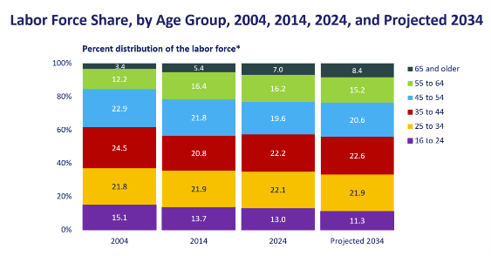
With more and healthier years of life, older adults are reinventing the definition of retirement, with an interest in all forms of work. Supporting continued workforce participation among those who want or need to work can be a tremendous asset by:
- Improving individual financial security;
- Supporting employers in mentoring younger employees and sharing valuable institutional knowledge;
- Addressing talent gaps in growth industries and older, more mature sectors;
- Enhancing state economic growth and prosperity; and
- Adding to the state and federal tax base that funds public service.
At an individual level, longevity has changed the financial and social realities of aging. Many people now spend 20 to 30 years in later life. With rising living costs, especially those related to health care, saving for retirement requires more resources than it did for past generations. Work constitutes the main contributor to financial stability and plays a key role in maintaining economic security over a longer lifespan (National Bureau of Economic Research, 2018).
Beyond financial benefits, continued engagement in work is associated with:
- Enhanced social engagement and connection,
- Continued mental stimulation, and
- A feeling of adding value and having a purpose.
Work also may be a potential savings for the state and federal government. When individuals remain engaged in the workforce, they are better positioned to prepare for future needs. Individuals who remain in the workforce are more likely to maintain access to employer-supported benefits such as healthcare, retirement savings plans, and employee assistance programs. Over time, these supports may reduce dependence on public systems and help individuals better prepare for future needs (AARP, 2022).
The State of MPAs Today
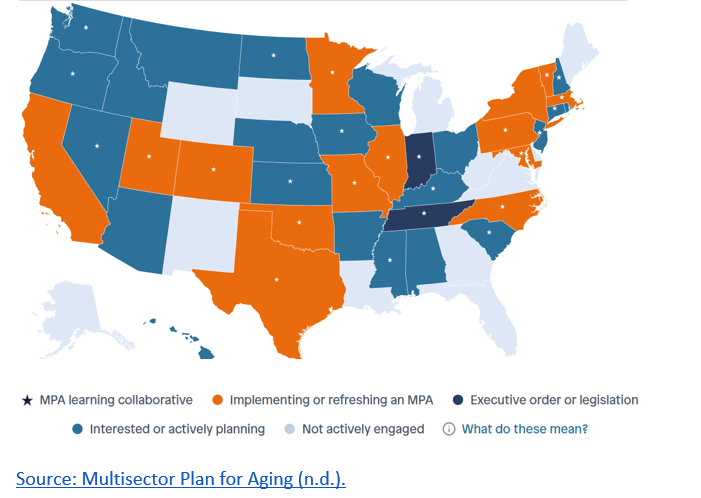
More than a dozen states have developed MPAs. Another 21 states are interested or are in the process of developing an MPA (Multisector Plan for Aging, n.d.).
Building on What Already Exists
Many MPAs already include a basic element and general support for the 50+ workforce by referencing age-friendly community ecosystems developed by the WHO or AARP Eight Domains of Livable Communities (AARP, n.d.). The domain that ties directly with 50+ work is Civic Participation and Employment. Strengthening work in this domain creates a clear pathway to expanding the labor force with more older adults.
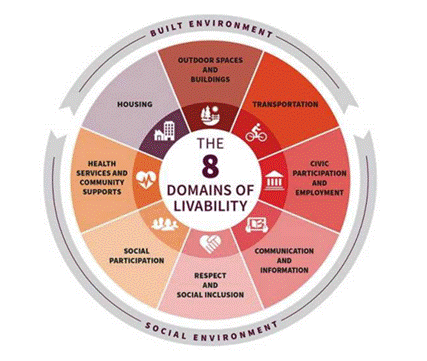
At the State Level: Examples of Workforce Strategies
While all plans have relatively robust goals focused on the traditional later life needs, nearly half have specific workforce-related strategies. States with more defined workforce goals or strategies include:
- California
- Colorado
- Maryland
- Minnesota
- New York
- Pennsylvania
These states have incorporated strategies such as job training and upskilling programs and employer engagement initiatives. In several cases, stakeholders have identified workforce participation as a component of financial security and healthy aging.
For the states that have defined 50+ work strategies, the most common elements included are shown in the chart below. Together, these strategies catalyze change. Over time, the goal is to connect and align tactics to grow the 50+ workforce.
Examples of 50+ Workforce Strategies in Existing MPAs
| Strategy Area | Description |
| Promote the value of older workers | Provide the business case for the older worker and intergenerational teams |
| Combat ageism | Employer education on age-friendly strategies and ageism, public awareness campaigns, and policy changes |
| Expand flexible work options | Part-time, phased retirement, gig, apprenticeships, and volunteer-to-work opportunities |
| Support caregivers | Workplace policies, training, and protections for working caregivers |
| Workforce training and upskilling | Reskilling, upskilling, lifelong learning, and career transition services |
| Improve data and awareness | Expanded labor force data on 50+ population, dashboards, and economic tracking |
| Enhance digital literacy and artificial intelligence training | Digital literacy and AI training for older workers |
| Encourage/support intergenerational workforces | Promote intergenerational teams and mentorships |
For the states that have yet to include a work goal or strategy, updating these plans to include 50+ workforce strategies would significantly broaden their impact on the livelihood of Americans. While important for today’s aging adults, it may be even more important for future generations who will live longer, requiring greater financial planning and saving.
At the Federal Level: A Similar Opportunity to Expand the Lens
Driven in large part by the momentum of the state MPAs, a federal MPA-like plan has emerged. In May 2024, the U.S. Department of Health and Human Services released “Aging in the United States: A Strategic Framework for a National Plan on Aging” (NPA), described as a framework for coordinating efforts across federal agencies and partners (The Interagency Coordinating Committee on Healthy Aging and Age Friendly Communities, 2024). The framework limits reference to older adults as contributors, focusing more on support than on purpose, engagement, and economic participation.
Using the above examples emerging from states, there is an opportunity to position older adults explicitly as contributors through encore careers, lifelong learning, and workforce participation. Expanding federal priorities to include employer engagement, workforce system, and educational alignment, along with training pathways, would boost employment success for older adults. Organizations such as AARP and the OECD have also emphasized that older worker participation is an important element of economic resilience and successful aging (AARP, 2022).
As more MPAs are developed, older MPAs are reviewed and updated. During reviews, assessments track progress and add new elements, which must include work as a core strategy. A robust 50+ Work Strategy would leverage all the existing elements and leverage new ways to elevate work opportunities for older job seekers. An introductory strategy might include a limited selection of elements in the 50+ Work Strategy chart.
With longer, healthier years of life, older adults are reinventing the definition of retirement, with an interest in all forms of work.
Call to Action
MPAs are currently among the most important tools states must prepare for demographic change. These multi-level frameworks have already catalyzed the development of a national plan, helping nearly three dozen state policymakers learn about demographic changes and the need to update aging policies and programs. The next step is to build on that foundation at both the state and federal levels.
Now is the time to act to ensure that 50+ workforce strategies are a core component of aging policy, not an afterthought.
A few practical starting points include:
- Review your state Multisector Plan on Aging (and the National Plan on Aging) through a 50+ workforce lens
- Identify different departments, partners, and stakeholders to help expand the workforce strategies
- Develop clear goals, knowing that starting small with actionable steps is key
An increase in longevity is one of the defining shifts of the last century. Preparing to support and capitalize on the opportunities and planning ahead for the challenges is good policy. MPAs and the NPA are drawing attention to state policies and programs with an eye toward revising benefits, updating service delivery models, and coordinating across agencies. By incorporating work and economic opportunity, these plans can help older adults stay financially secure, connected, and engaged, and ease pressure on strained support systems.
Karen M. Brown, MBA, is CEO, iAging and Partner, Age Inclusive Management Strategies (AIMS) as well as Chair – Colorado Commission on Aging Workforce Committee in Arvada, Colorado. She can be reached at Karen.Peffer.Brown@gmail.com.
Photo credit: Shutterstock/Lomb
References
AARP. (n.d.). The 8 domains of livability: An introduction. https://www.aarp.org/livable-communities/network-age-friendly-communities/info-2016/8-domains-of-livability-introduction.html
AARP. (2022). The longevity economy outlook. https://www.aarp.org/pri/topics/work-finances-retirement/economics-aging/longevity-economy-outlook/
Brookings Institution (2020) – The Growing Importance of older workers
Colello, K. J., & Napili, A. (2024). Older Americans Act: Overview and funding. Congressional Research Service. https://www.congress.gov/crs-product/R43414
Interagency Coordinating Committee on Health Aging. (2024, May). Aging in the United States: A Strategic framework for a national plan on aging. U.S. Department of Health, and Human Services. https://acl.gov/sites/default/files/ICC-Aging/StrategicFramework-NationalPlanOnAging-2024.pdf
Multisector Plan for Aging. (n.d.). Map. https://multisectorplanforaging.org/map
National Bureau of Economic Research (2018), The Impact of Aging on Labor Markets and the Economy
Office of Employment and Unemployment Statistics. (2025, August 28). Labor force projections. U.S. Department of Labor, Bureau of Labor Statistics. https://www.bls.gov/emp/data/labor-force.htm
Organization for Economic Co-operation and Development. (2023, December 13). Improving opportunities and working conditions for older workers can bolster pension system sustainability and address labour market shortages. https://www.oecd.org/en/about/news/press-releases/2023/12/improving-opportunities-and-working-conditions-for-older-workers-can-bolster-pension-system-sustainability-and-address-labour-market-shortages
U.S. Census Bureau. (2023). National population projections tables: Main series. U.S. Department of Commerce. https://www.census.gov/data/tables/2023/demo/popproj/2023-summary-tables.html
World Economic Forum. (2023). The future of jobs report. https://www.weforum.org/publications/the-future-of-jobs-report-2023/
World Health Organization. (2020). Decade of Healthy Ageing 2020-2030
.