

Abstract
As the workforce ages and talent shortages persist, organizations face a misalignment between available talent and hiring strategies. This article reframes longer life expectancy as a strategic advantage, positioning experienced workers as an underleveraged driver of performance, stability, and growth. Using SHRM data, it challenges assumptions, highlights the business case for experience, and outlines shifts in hiring, learning, and workplace design. The findings reveal organizations that align talent strategies with demographic reality will compete more effectively in today’s labor market.
Key Words
Aging workforce, experienced workers, older workers, talent strategy, skills-based hiring, age bias, intergenerational, future of work, labor shortages, SHRM
We spent decades preparing for the challenges of an aging population. We debated retirement sustainability, rising healthcare costs, and pressure on public systems.
And in doing so, we missed the bigger story. We treated longer life expectancy as a liability to be offset rather than an asset to be leveraged.
This is not a deficit moment. It’s a strategic one.
At SHRM, we describe this era as the Age of Opportunity—a period where experience, if properly leveraged, becomes a driver of economic growth, organizational performance, and workforce resilience. Work is about more than just income. It’s about dignity, purpose, and continued contribution. It provides individuals with the ability to retain economic security while continuing to engage, grow, and contribute in meaningful ways. And for employers, it represents access to a talent pool that’s already proven but too often overlooked.
As a member-driven catalyst for creating better workplaces where people and businesses thrive together, SHRM has a direct view of how talent, policy, and workplace practices intersect. With nearly 340,000 members across 180 countries spanning industries and sectors, that vantage point makes one thing clear: To remain competitive, organizations must challenge outdated assumptions about how they recognize and deploy experienced workers.
A Changing Labor Force
Two realities are shaping the workforce and they’re often discussed separately when they should be considered together. The workforce is aging, with people aged 55 and older representing the fastest-growing segment of the labor force for more than two decades (Stinson & Wang, 2025). Those 65 and older in the workforce are now the fastest-growing cohort, with many (61.8%) continuing to work full time (SHRM, 2025b). This is not a temporary shift. It’s a structural change in the composition of the labor force—one that’s redefining who’s available to work, how long careers last, and what workforce participation looks like over time.
Despite advances in technology and expanded access to education and training, organizations are finding it increasingly difficult to match available talent with business needs.
The second reality is employers are struggling to find talent. Sixty-nine percent of organizations report difficulty filling full-time positions—a challenge consistent since 2016 (SHRM, 2019). Skills gaps continue to widen, particularly in areas such as problem-solving, systems thinking, and technical capability. Despite advances in technology and expanded access to education and training, organizations are finding it increasingly difficult to match available talent with business needs.
The reason is not a lack of talent. It’s a lack of alignment.
Talent strategies have not kept pace with workforce realities. Too many organizations still design work around early-career trajectories, recruit from narrow pipelines, and equate potential with youth rather than capability. They rely on outdated signals—such as years since graduation or linear career progression—to make decisions about who is worth investing in. In doing so, they systematically overlook a growing segment of the workforce that is ready, willing, and able to contribute.
The result is a paradox: The fastest-growing segment of the workforce is also one of the most underleveraged. This is not a supply issue. It’s a systems issue. Policies, practices, and workplace cultures were built for a different era, and they have not evolved to reflect a workforce that’s living longer, working longer, and contributing longer.
That misalignment carries real consequences. In a labor market defined by scarcity, organizations cannot afford to overlook viable talent. Yet many continue to do so, not out of intent, but out of inertia. Systems built decades ago continue to shape decisions today, even as the workforce itself has fundamentally changed.
The Value of Experience
In a knowledge-driven economy, experience is not burdensome—it’s a competitive advantage. Experienced workers bring institutional knowledge, strong judgment informed by years of context, and the ability to make decisions with speed and clarity. They bring pattern recognition that helps organizations anticipate challenges, not just react to them. And they bring stability at a time when volatility has become the norm.
They also bring measurable business value. Experienced workers tend to have higher levels of engagement and organizational commitment. They’re more likely to stay in their roles, reducing turnover costs that can range from 50% to 200% of annual salary (SHRM, 2025c). In an environment where retention is increasingly difficult and expensive, stability matters. SHRM research reinforces what many leaders already see firsthand: Experienced workers demonstrate loyalty, bring specialized expertise, and contribute meaningfully to organizational performance (SHRM, 2025a).
The fastest-growing segment of the workforce is also one of the most underleveraged. This is not a supply issue. It’s a systems issue.
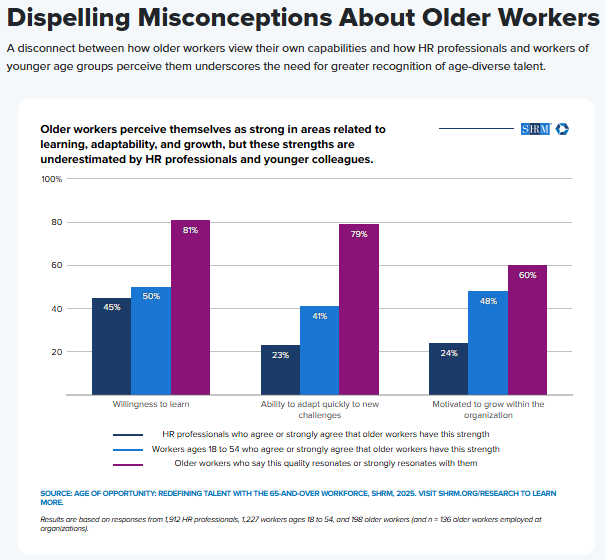
Equally important, our data challenges long-standing assumptions about adaptability. A majority of experienced workers are open to reskilling and upskilling, including in emerging areas such as AI (SHRM, 2025a). Among older workers employed by organizations, 74% are somewhat or very willing to participate in AI upskilling initiatives if offered by their employer. Even more compelling, 81% of older workers are somewhat or very confident in their ability to learn and adapt to new workplace technologies (SHRM, 2025a). Older workers are not resistant to change. In fact, they’ve spent their careers navigating it.
The Perception Gap
The issue, then, is not capability. It’s perception.
For too long, experience has been framed as something retrospective—a reflection of what has already been done rather than an indicator of what can be achieved. That framing no longer holds. Experience is not a liability. It’s a multiplier of future performance.
Yet despite this, age bias remains one of the most persistent—and often invisible—barriers in the workplace. It rarely presents as overt discrimination. More often, it’s embedded in language, systems, and assumptions. It appears in job descriptions that subtly signal a preference for younger candidates. It appears in hiring criteria tied to years since graduation. It appears in development opportunities disproportionately offered to early-career employees, based on assumptions about who has “runway” and who does not.
These signals shape how organizations define potential, and in doing so, they determine who is given the opportunity to contribute and grow. Over time, they reinforce a cycle in which experienced workers are overlooked, not because they lack the ability to perform but because systems are not designed to recognize it.
Legal frameworks establish important guardrails but compliance alone is not a winning strategy. Organizations that approach age inclusion solely through a legal lens will continue to underutilize one of the most valuable segments of their workforce. This is not just about avoiding risk. It’s about unlocking value.
New Ideas for a New Day
Unlocking that value requires intentional design across the full employment lifecycle. It begins with hiring. Organizations must expand their talent acquisition strategies to include experienced workers who are ready to contribute, whether they’re remaining in the workforce or re-entering it. That requires a shift toward skills-based hiring—focusing on what individuals can do, rather than screening for graduation dates, which often excludes qualified candidates. It also requires a deliberate effort to remove age-coded language and broaden sourcing strategies.
In a rapidly changing environment, the ability to continuously learn is not optional. It’s essential. And that expectation must apply across all career stages.
It continues with learning and development. In a rapidly changing environment, the ability to continuously learn is not optional. It’s essential. And that expectation must apply across all career stages. Capability does not have an expiration date.
Workplace design must evolve as well. Flexibility, phased retirement, caregiving support, and health-related benefits are often framed as accommodations, but they’re better understood as workforce strategies. They enable participation across life stages and recognize careers are no longer linear. As individuals live and work longer, organizations must design roles and structures that allow for different rhythms of contribution over time.
Equally important is the intentional cultivation of intergenerational teams. When designed effectively, these teams combine complementary strengths, pairing experience with new perspectives to drive innovation and performance. This is not about balancing generations. It’s about integrating them in ways that strengthen outcomes. Organizations that do this well are not just more inclusive; they’re more effective.
Public Policy Must Keep Pace
This conversation does not stop at the workplace. It extends to public policy. Many of today’s systems—from retirement structures to workforce incentives—were designed for a different era, when careers were shorter and life expectancy was lower. That model no longer reflects reality. People are living longer, healthier lives and are both willing and able to contribute for longer periods of time.
Policy must evolve from enabling exit to enabling contribution. That means investing in lifelong learning, strengthening pathways for continued workforce participation, and aligning incentives with a workforce that no longer follows a linear trajectory. Employers cannot solve this challenge alone. Alignment between public policy and workforce practice will be essential to unlocking the full potential of experienced workers.
The question is no longer whether the workforce is aging. It’s whether our strategies are evolving with it. Organizations that recognize this shift will compete differently, because they will be drawing from the full spectrum of available talent, not a narrow slice of it. The advantage will not come from finding new talent. It will come from finally taking advantage of the talent that has been there all along.
The talent is here. The data is clear. The business case is strong. The question is whether organizations are willing to adjust their strategies to match reality.
This is the Age of Opportunity. And the opportunity is ours to unlock.
Johnny C. Taylor, Jr., J.D., SHRM-SCP, is President and Chief Executive Officer of SHRM, Alexandria, Virginia.
Photo credit: Shutterstock/tsyhun
References
SHRM. (2025a). Age of opportunity: Redefining talent with the 65-and-over workforce. https://www.shrm.org/content/dam/en/shrm/foundation/2025_untapped_talent_age_of_opportunity_redefining_talent_with_the_65-and-over_workforce.pdf
SHRM. (2025b). Labor force snapshot: Older people in the U.S. labor force. https://www.shrm.org/content/dam/en/shrm/topics-tools/research/labor-force-snapshot-older-people-in-the-u-s-labor-force.pdf
SHRM. (2025c). The Myth of Replaceability: Preparing for the Loss of Key Employees. https://www.shrm.org/executive-network/insights/myth-replaceability-preparing-loss-key-employees
SHRM. (2019). The skills gap. https://www.shrm.org/content/dam/en/shrm/research/SHRM-Skills-Gap-2019.pdf
Stinson, M. & Wang, S. (2025). The composition of firm workforces from 2006-2022: Findings from the business dynamics statistics of human capital experimental product. United States Census Bureau. https://www.census.gov/library/working-papers/2025/adrm/CES-WP-25-20.html