

Abstract
As public-sector employers face the realities of an aging workforce, Pitkin County government in Aspen, Colorado, chose to respond by listening first. Through employee focus groups and survey data, the county identified a growing need for flexible retirement pathways, benefit continuity, and emotional support during career transitions. In response, Pitkin County developed a comprehensive age-inclusive workforce strategy that includes phased retirement, retire–rehire opportunities, retirement bootcamps, financial education, wellness resources, and community partnerships. This article explores how intentional listening led to innovative workforce programs that preserve institutional knowledge, support employee well-being, and reframe retirement as a meaningful transition rather than an abrupt exit from public service.
Key Words
Aging workforce, age-inclusive, retirement, phased retirement, workforce longevity, employee retention, transition, flexible work arrangements, organizational culture, employee well-being, retire-rehire, county government, institutional knowledge, age-friendly community
Across the United States, public-sector employers are grappling with a demographic reality: Our workforce is aging, institutional knowledge is at risk, and retirement is no longer a one-size-fits-all event. According to a report by SHRM (2025), the number of Americans ages 65 and older has increased by 457%, exponentially more than any other age group. We are also in an unprecedented time where there are five generations in the workforce. The workforce in our Pitkin County Government, in Aspen, Colorado, spans the ages of 21 to 83, we have a retention rate just shy of 90%, and our longest serving employee celebrated 50 years in 2026.
At its core, Pitkin County is a small, tight-knit community of 17,000 people in the Rocky Mountains shaped by both its natural environment and its sense of responsibility to it. The county seat is Aspen, Colorado, where the population can expand to over 50,000 during peak times and put strain on services as folks come to enjoy skiing, rafting, music concerts, and world-class restaurants.
Our organization, Pitkin County, has 400 employees spread across 27 departments who provide services to our community, including a senior center, an airport, public safety, and many more. We employ mostly full-time employees with two peak seasons, in the winter for the airport and in the spring for open space and trails.
We put together a comprehensive approach to what began as a simple question: How can we better support employees over the age of 50 and help truly prepare them for future chapters of their life?
In 2021, Pitkin County partnered with Guest Editors Karen Brown and Brian Kaskie on a grant to support the intergenerational workforce. With their expertise and guidance, we put together a comprehensive approach to what began as a simple question: How can we better support employees over the age of 50 and help truly prepare them for future chapters of their life?
We convened a small team to brainstorm and map how we would answer this question. We researched best practices, had many conversations, and planned a comprehensive, data-informed strategy that reimagines retirement, introduces phased work, and promotes longevity in the workplace.
We gathered initial data via a survey of all employees aged 50 and over and invited them to a focus group to gather anecdotal feedback. Our survey response rate was 77%, and 30 employees attended a two-hour focus group session with lunch. We narrowed our questions down to three areas. We asked about their largest challenge approaching retirement, what an age-friendly workplace looks like, and what they would want to learn about if the county provided a “Retirement Bootcamp” series.
Our intentional and guided approach taught us that supporting an intergenerational workforce is not a compliance exercise; it’s a cultural commitment that allows us to think outside the box and enables us to integrate our organizational values of stewardship, collaboration, and a positive work environment. One of the most rewarding aspects of this was co-creating workplace programs and policies in partnership with our senior services division and its Age-Friendly Community initiatives to retain our employees and make our community stronger.
Listen Before Designing
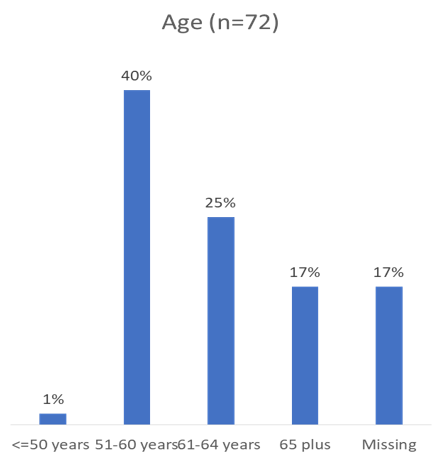
In 2022, we had a total workforce of 316 employees, of whom 112 were aged 50 and above. Eighteen percent of our workforce was aged 60 and above, and 7% was aged 65-plus. We were at risk of losing 25% of our workforce and had already seen an exodus of retirees leaving during COVID-19. We knew this was only the beginning of the retirements. The graph below shows the ages of staff who participated in the survey. A total of 72 employees who voluntarily took the survey.
We wanted to understand what they actually wanted—not what we assumed they needed. The responses were clear. When asked about interest in retirement-related programs, employees expressed strong support for phased retirement and retire–rehire options.
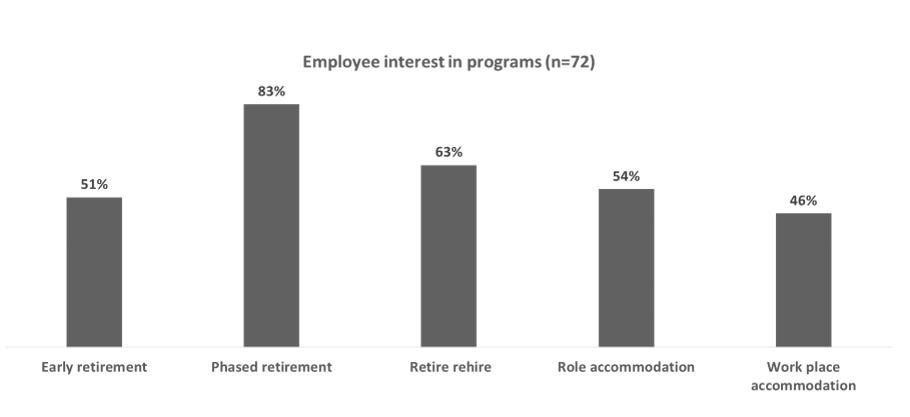
*Multiple answers were allowed
Interestingly, 71% of respondents said they would consider returning as a consultant without benefits after retirement—a powerful signal that employees were not seeking abrupt exits, but flexible transitions that still allowed them to add value and contribute. We also asked what mattered most in a phased retirement structure. The top priority was unmistakably continued health insurance, which 80% of respondents ranked number one. The message was clear: employees wanted flexibility, continuity of benefits, and pathways to remain connected.
Building a Flexible Retirement Ecosystem
Rather than offering isolated policies, we developed a comprehensive Retirement Bootcamp program. We reviewed and identified themes from the survey and focus group, clustered them into areas, and began connecting resources through our partners and vendors, in-house subject-matter experts, and cross-departmental collaboration with senior services. The Human Resources team created a multi-series program that prepares employees for the financial, logistical, social, and emotional dimensions of retirement. Sessions include:
- 401(a) withdrawal strategies and fee comparisons;
- Medicare timing and HSA coordination;
- Social Security planning;
- Lifestyle and identity transitions; and
- Purpose-building frameworks such as PERMA-V, a science-based foundation for well-being and flourishing.
The Bootcamp also addresses specific community needs. For example, Spanish-language resources and retirement questions were integrated into planning materials to recognize the diversity within our workforce and our community. We partnered with local organizations, such as our Agency on Aging SHIP counseling and our senior services division, to ensure that Medicare navigation assistance was accessible and culturally responsive, as well as other programs and services available to older adults.
Interestingly, 71% of respondents said they would consider returning as a consultant without benefits after retirement—a powerful signal that employees were not seeking abrupt exits, but flexible transitions that still allowed them to add value and contribute
The Retirement Handbook is a practical guide that reframes retirement as a supported transition rather than an administrative offboarding. The Retirement Handbook: Your Guide to Planning the Next Chapter includes phased retirement options, financial planning guidance, Medicare and Social Security education, emotional and mental readiness resources, local community services, and a structured retirement checklist. We emphasize that retirement is “not the end of something—it’s the beginning of something new.” This framing reinforces respect for longevity, knowledge, and contribution.
Phased Retirement: A Flexible Bridge with Benefit Options
Employees made it clear they did not want an abrupt end to decades of service. In response, we formalized phased, customizable retirement pathways, which allow employees to voluntarily reduce their full-time equivalency, adjust schedules, or serve in mentorship or advisory roles while planning their transition. Depending on individual and departmental needs, an individual can decrease hours to as few as 10 per week, but must keep a minimum of 30 hours per week to be eligible for health benefits. If employees work between 20 and 29 hours per week, they’re still eligible to accrue paid time off, disability benefits, and retirement contributions. This is a win-win for the employee and the organization.
Within our Retirement Bootcamp series, the HR team created a webinar for Phased Retirement, which reviews what it is, the process of beginning the discussion with managers, and when to collaborate with human resources to dive into the details, such as the reduction in hours, and how that may affect benefits, salary, and retirement contributions.
This structure accomplishes several goals simultaneously, including preserving institutional knowledge, allowing intentional succession planning, maintaining benefits continuity, supporting emotional adjustment, and reducing burnout in physically demanding roles. In job responsibilities where frontline work—from plowing roads during a snowstorm to long shifts that involve many diverse roles in public safety—is physically taxing, this flexibility is not a luxury. It is a culture and retention strategy.
With 71% of respondents expressing interest in consulting post-retirement, we created retire–rehire pathways that allow retirees to return in part-time, on-call, or project-based roles without benefits. This has helped tremendously with supporting project continuity, preserving subject-matter expertise, providing flexible income options for retirees, and strengthening intergenerational mentorship. Rather than viewing retirement as a loss, we reframed it as an opportunity for a structured legacy transfer.
Treating retirement as a transition, not a transaction, has been a key takeaway.
This is also customizable based on the employee’s needs, the department’s needs, and the type of expertise or services that are provided. For example, we have had employees retire, and we rehire them as consultants to finish out major projects, such as a community development comprehensive community plan for the next 25 years, or to provide intentional succession planning transitions that allow the staff, community, and organization to manage the amount of change for all.
Conclusion
Our journey down this path has increased retention rates and led employees to delay their retirement while continuing to contribute to our organization’s vision and mission. We learned that starting with employees’ voices helped shape our design, and assumptions would have missed key priorities. Treating retirement as a transition, not a transaction, has been a key takeaway for us. Emotional readiness deserves equal attention to financial readiness, especially to ensure the success of the journey our retirees are leaving behind.
Protecting benefits continuity is central to workforce confidence. Building flexible off-ramps preserves knowledge and dignity. Integrating community resources, such as our Senior Services division, Medicare navigators, and financial advisors, is critical. Making education ongoing and transparent empowers informed decision-making and increases confidence for employees’ next chapters.
Organizations cannot afford to lose decades of expertise without intention. Nor can they afford to ignore the aspirations of employees who want to contribute longer—just differently. By listening first, co-creating, and framing retirement as a supported life transition, Pitkin County has moved from reactive retirement management to proactive age-inclusion workforce planning.
Our Retirement Handbook closes with a simple message: “Your next chapter starts here.” For us, that next chapter is not just about individual employees. It is about building a government workplace that values longevity, flexibility, and human dignity at every stage of the career lifecycle. Supporting a workforce is not about preparing people to leave. It is about preparing organizations and people to evolve for the better. For more information on our program, please visit our Pitkin County HR website.
Melissa Knight, MEd, SHRM-CP, PHR, is the Human Resources and Risk Management Director for Pitkin County, in Aspen, CO. She may be reached at melissa.knight@pitkincounty.com.
Chad Federwitz, PhD, CPG, is the Senior Services Manager for Pitkin County, in Aspen, CO. He may be reached at chad.federwitz@pitkincounty.com.
Reference
SHRM. (2025). Age of opportunity: Redefining talent with the 65-and-over workforce. https://www.shrm.org/topics-tools/research/redefining-talent-with-65-over-workforce