

This May we’re running a four-part series of blog posts from our sponsors at the Cambia Health Foundation, which highlights the work of their local community partners.
Grief is often described as universal, yet it is frequently experienced in isolation—particularly among older adults. Loss accumulates across the lifespan: the death of loved ones, changes in health, the end of careers, shifts in identity and altered family roles. For many, these experiences are compounded by social isolation, limited access to mental health resources, and a cultural discomfort with talking openly about grief.
In many cultures around the world, grief is woven into communal life through shared rituals and remembrance. Mourning is recognized as a collective experience—something to be witnessed and carried together over time. In contrast, grief in the United States is often treated as a private matter, expected to be managed quietly or resolved within a socially acceptable timeframe. This framing can leave individuals, particularly older adults, feeling as though their grief is something to hide or endure alone. At Thadd’s Place, a nonprofit community grief center in rural Oregon, grief is approached not as a problem to be fixed, but as a human experience that deserves recognition and companionship. Guided by the belief that nobody grieves alone, the organization has built a welcoming, intergenerational model of grief support that restores communal presence to the grieving process—reducing stigma, strengthening connection and honoring grief across the lifespan.
Grief as a Community Experience
Traditional grief support systems often rely on time-limited counseling or interventions that can feel inaccessible or intimidating—especially for older adults facing barriers related to transportation, cost or stigma around mental health services. Thadd’s Place offers an alternative: free, community-based grief support that centers presence and shared humanity.
“Helping with activities like the golf tournament and working with kids through art projects is something I can do in my husband’s memory. It helps me while helping others.”
The organization’s work is grounded in Dr. Alan Wolfelt’s Companioning Model of Grief, which emphasizes walking alongside grieving individuals rather than directing or diagnosing them. This approach creates space for people to tell their stories, listen deeply, and discover that their grief does not need to be hidden, fixed or hurried.
For older adults, this model can be especially meaningful. Many arrive having experienced multiple losses—spouses, siblings, friends, independence or familiar routines. Some are supporting grandchildren or younger family members through their own losses, while others grieve alone, unsure where they belong in a culture that often expects resilience. At Thadd’s Place, grief is named, normalized and shared.
Reducing Isolation Through Belonging
Social isolation is a growing public health concern among older adults, and grief can intensify this isolation. Thadd’s Place counters this by fostering consistent, relationship-based programming that invites people back—not just during the immediate aftermath of loss, but over time.
Support groups are facilitated by trained volunteers and staff who understand that healing does not follow a timeline. Participants are not required to speak, “be positive,” or move toward closure. Instead, they are offered something many have not experienced elsewhere: permission to be exactly where they are, and to feel exactly what they’re feeling.
“Being able to give back through activities at Thadd’s Place has given me a purpose,” said Jan, a volunteer at Thadd’s Place. “Helping with activities like the golf tournament and working with kids through art projects is something I can do in my husband’s memory. It helps me while helping others.”
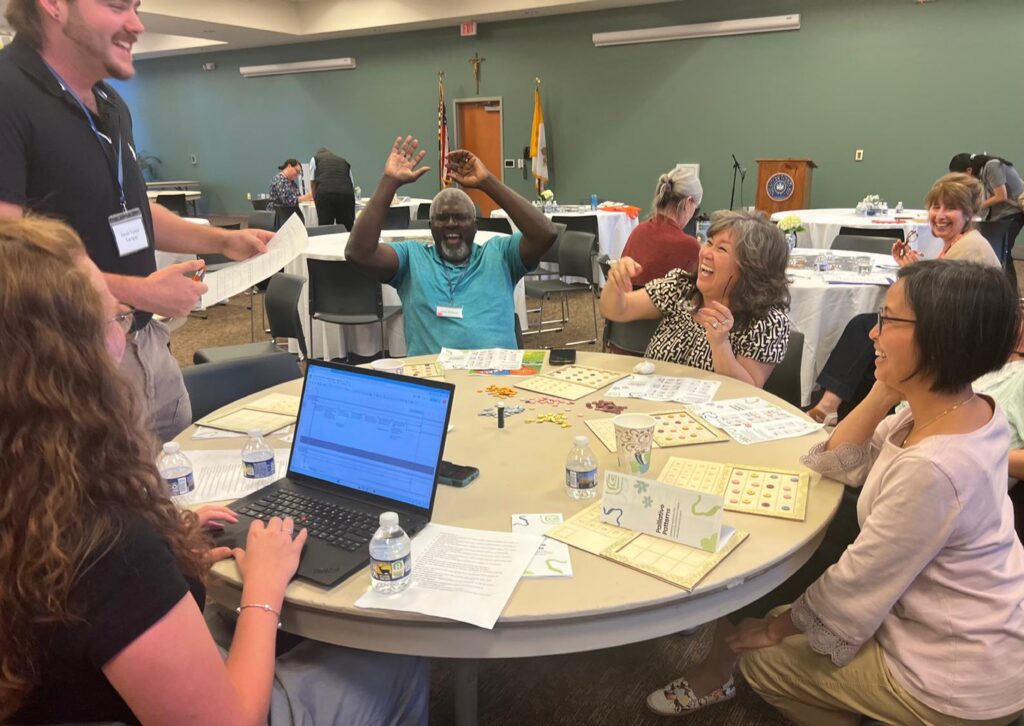
In addition to structured support groups, Thadd’s Place incorporates familiar community activities as pathways to connection. One example is Community Bingo, a monthly gathering designed to reduce social isolation among older adults while quietly normalizing conversations about grief. Bingo is a recognizable, low-pressure activity for participants who may be hesitant to attend a grief group or unsure whether their experience “counts” as grief. Over time, relationships formed in these settings often open the door to deeper conversations and participation in other programs.
By embedding grief support within familiar social spaces, Community Bingo helps reduce stigma without requiring individuals to identify themselves as grieving. Participants are simply invited into community where connection becomes the first step toward healing.
An Intergenerational Model That Reflects Real Families
Grief doesn’t affect just one person; it moves through families, friendships, and communities, often across generations. Thadd’s Place reflects this reality by offering programs that bring children, teens and adults into shared spaces of support.
Alongside adult grief groups, the organization offers creative, art-based programs for children and teens, allowing younger participants to express emotions that may be difficult to articulate. These programs are especially meaningful for grandparents raising grandchildren or supporting younger family members through loss, foster care transitions, divorce or other life-altering changes.
By serving multiple generations under one roof, Thadd’s Place reduces the burden on caregivers and reinforces the idea that grief is not something to shield children from, nor something older adults must carry alone.
Breaking the Silence Around Grief
Stigma remains one of the greatest barriers to grief support. In many rural farming communities, resilience has long been a necessity, passed down through generations with messages such as “keep going,” “don’t talk about it” or “don’t cry in front of others.” While people who carry these beliefs may see them as reflecting strength and perseverance, these messages can be problematic, making it difficult—especially for older adults—to name grief or seek support, and potentially leading to chronic emotional and physical health issues down the road.
Thadd’s Place meets people where they are by embedding grief support into the fabric of the community in ways that feel familiar and accessible. Rather than asking people to abandon deeply held beliefs, the organization offers spaces where grief can be acknowledged quietly or spoken aloud, shared over time, and carried together—without judgment or pressure.
By serving multiple generations under one roof, Thadd’s Place reduces the burden on caregivers and reinforces the idea that grief is not something to shield children from, nor something older adults must carry alone.
The organization was inspired by the life and values of its namesake, whose deep love for his community, its way of life, and the relationships he built over decades continue to shape the work today. Thadd understood the quiet strength of rural communities—the importance of lending a hand and standing by one another through hardship and joy. That same spirit remains at the heart of Thadd’s Place.
Public events, volunteer engagement, and outreach efforts position grief as a natural response to loss, not a weakness. Programs are open to anyone grieving, regardless of the type of loss or how long ago it occurred, sending a clear message: your grief belongs here. Volunteers—many of whom have experienced grief themselves—play a critical role, reinforcing that grief support is a shared community responsibility.
A Replicable Model for Aging Communities
At its core, Thadd’s Place is a reminder that grief deserves space, time and compassion. By bringing people together across generations and life experiences, the organization reduces isolation, challenges stigma, and affirms that grief is not something to get through alone.
While Thadd’s Place serves a specific rural region, its model offers valuable lessons for aging services and providers nationwide. By prioritizing accessibility and intergenerational connection, grief support becomes embedded in community life rather than separate from it.
As communities seek ways to address isolation, mental health, and aging with dignity, grief support must be part of the conversation. Loss is inevitable; loneliness does not have to be.
Photo credit: Shutterstock