
My best friend, Shelby, who is about my own age—30—worries about losing friends. She fears forfeitures over miscommunications, passive aggressions, waning contact leading to quiet disconnections.
I can’t relate.
Shelby and I have been friends since middle school. I’m unafraid of losing her, for our friendship is till death do us part. The beauty of that morbid sentiment is, if all goes well, we can defer worrying about our friendship’s expiration for a few decades.
On the contrary, I fear the end of my other friendships—not to miscommunication or aggression or fading away—but to death.
This fear isn’t the product of paranoia, but because nearly all of my friends are 30 to 65 years my senior.
I’ve met my older friends in a multitude of ways. Some started out as book subjects (I’m a private biographer for people over age 65) and remained an integral part of my life thereafter. I met a few through church or my husband’s Rotary Club. Others were the children of my older friends who have died, and I playfully refer to them as my inheritance.
Shared Interests
One contributing factor to my falling into so many intergenerational friendships may be that my interests—genealogy, history, and reading poetry—are commonly held by my elders. Another cause may be I’m attracted to what older people have to offer: wisdom my peers innately lack, a wealth of interesting stories, and hope things will turn out alright since my older friends have survived so much.
There’s 93-year-old Dr. Fisher, who once bravely boarded a bomber day in and day out and took the flak during WWII. We could discuss history for hours. Throughout my friend Doug’s 80s, he and I exchanged letters and met for ice cream. With Sharane, who is 46 years my senior, I pick flowers, cry, redecorate the house—proof girls will be girls at all ages. Then there’s 79-year-old Sherry Kay, a Tennessee native with a Southern accent; she and I play bingo with my toddler way past her bedtime. When it comes to 88-year-old Fred, I scarcely let a week go by without a lengthy phone call.
None of us is guaranteed tomorrow, but my older friends are more cognizant of that truth than my peers.
Most of my friends are in the precarious period of a lifecycle where the clock is ticking, the hourglass sand slipping. None of us is guaranteed tomorrow, but my older friends are more cognizant of that truth than my peers. And I’m painfully aware of my older friends’ mortalities.
When one of my older friends doesn’t answer the phone or text back, I strap on worry like a bomb vest. I try to talk myself off the ledge: they have a life, their phone is on silent, they’re gallivanting through Europe. I breathe a sigh of relief when they respond. But other times, my fear is valid.
When Doug didn’t write back, his son wrote me, relaying what I had been afraid of had come true. When Sharane didn’t answer on Friday night and again on Saturday morning, my fear rendered me unable to think straight until I drove to her house, found her disoriented, and got her to a hospital for heart surgery in time. When Dr. Fisher didn’t call, he’d been hospitalized. Then, when he was dying, he accepted his fate and disclosed he thought he’d led a good life, walking out God’s plans.
Since most of my friends are nearing or surpassing their life expectancies, I wonder if I can bear the losses. I’ve already held enough hands at deathbed-sides and written too many obituaries.
For years, I viewed my fear as a negative thing: something that stole my peace. But then, my perspective shifted.
One afternoon on Sherry Kay’s lanai, we both clasped hot mugs of coffee, and I laughed at one of her hilarious Southern sayings. I watched her grin widen, her blue eyes twinkle, her silver hair whirl in the breeze. I thought, “Can she and I still laugh like this 10 years from now? Probably not 20.”
As an awareness that this joyous moment was temporary settled, it didn’t disturb me like similar morose thoughts usually did. Instead, the awareness made me sink back in my seat, relax, and laugh harder.
Ever since then, I’ve come to see the fear of my friends’ impending deaths not as a negative force, but as a positive one.
I’ve come to see the fear of my friends’ impending deaths not as a negative force, but as a positive one.
Whenever I’m beside my older friends, because I fear a day when I can’t sit beside them, I especially soak it in. Like I wouldn’t take any fleeting splendor for granted—a shooting star, a rainbow, a blazing sunset—I don’t take our time together for granted either. I slow down and dwell wholly in the moment. I breathe deeper. I drink my coffee while it’s still warm. I listen intently as my friends tell funny stories, open up, or share wisdom. I don’t rush to speak or get onto the next thing on my to-do list. I bask in their presence.
While I understand I should bestow similar reverence upon all of my interactions with loved ones, I’m guilty of hastening through life and not always paying enough attention to all my relationships with the same seriousness I do my older friends. Only on Sherry Kay’s lanai did I ask myself why.
The answer? Fear.
Fear can be a positive motivator. Clearly, fearing my friends’ absences makes me live more purposefully. This fear is a powerful stimulus that ushers in leisure, grounded presence, devotion, and deep connection—all positives. More broadly, this fear leads me to ascertain that not only is my time with my older friends temporary, but every instant of what poet Mary Oliver called my “one wild and precious life” is temporary, too.
Unless I’m struck by lightning or diagnosed with a terminal disease, I’ll probably live much further into the future than the friends I love most.
One day, in the winter of my one wild and precious life, I’ll stand on the future’s shore, likely with only Shelby and without the solace, guidance, and love of my older friends. I dread that future, no matter how beautiful the view or how serene the sound of the waves—the loveliness of which I know I’ll want to share with my older friends, to no avail.
Although I recognize the benefits of fearing my friends’ deaths, I still look to the future with trepidation, imagining the voids it holds.
Imparting Wisdom
My older friends, who have lived much longer and learned much more than me, have imparted wisdom I can learn from. Most, like the dying Dr. Fisher, conveyed through their words or actions that they’ve found peace in learning to accept whatever they cannot change.
After I expressed my fear to 88-year-old Fred, he said, “I’ll hold onto you as long as I can. But that’s all I can do.”
I nodded, knowing I should accept that, too.
In the future, when my fear is a reality and my older friends are no longer here, perhaps I can lean on what they taught me, even without meaning to: to hit the brakes. Maybe I’ll have lived my one wild and precious life slower and more intentionally, acknowledging the ephemeralness of my brief lifetime that should be decelerated and embraced with sanctity.
For now, as I try to accept what I cannot change, savoring the present with my older friends and knowing I’ll always carry their influence into the future quells some of my fears.
With what remains of my fear, I will use as fuel: fuel to be present and behold the fleeting splendors that take shape in those I love.
Olivia Savoie is a family heirloom biographer based in Lafayette, Louisiana. Her essays have appeared in several publications, and she has spoken about her writing on CBS Mornings and The Kelly Clarkson Show.
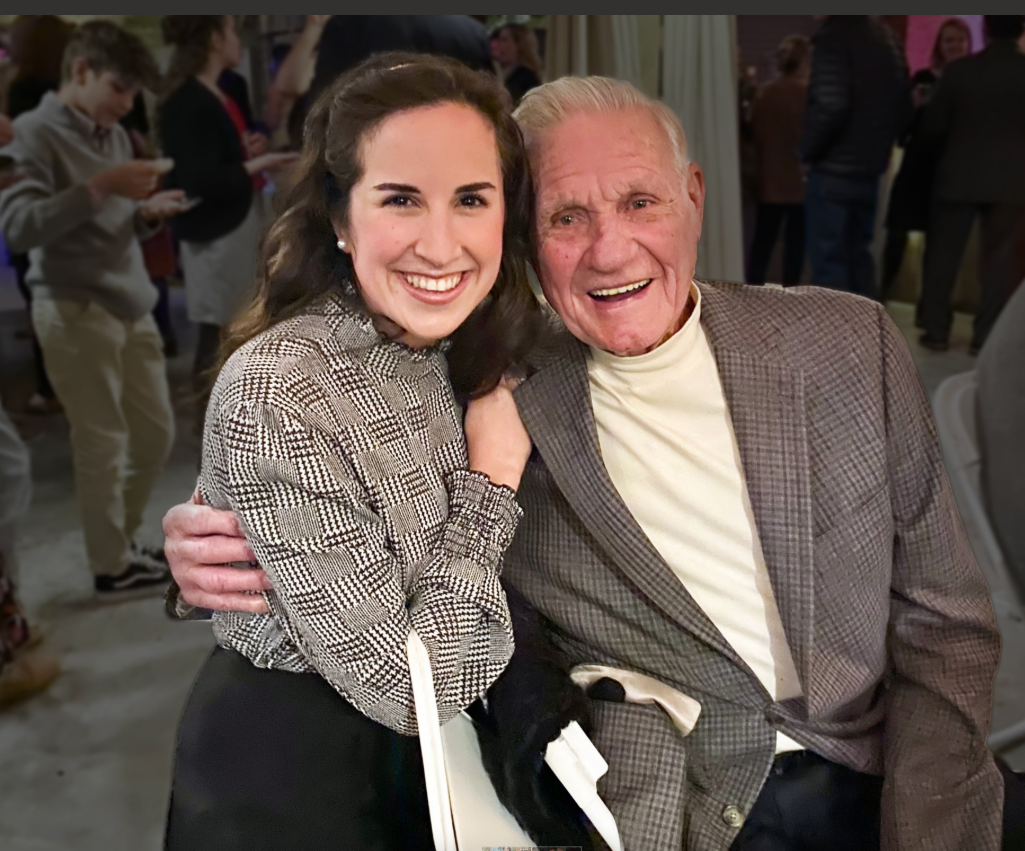
Photo credit: Olivia Savoie with the late Dr. Fisher.