

Despite the enormous value of home care workforce to millions of older adults and people with disabilities, their jobs remain critically undervalued. As a result, these workers are often financially forced out of these jobs or avoid them altogether, making it difficult to imagine how employers will fill the anticipated 9.7 million direct care job openings over the next decade.
During such times, AI (or “artificial intelligence”) can serve as a workforce multiplier, relieving direct care workers of responsibilities that can be automated, allowing them to focus on delivering high-quality, person-centered care to their clients. It can also streamline administrative and repetitive tasks for agencies, smoothing their operations allowing them to focus on staff engagement and development. Yet how is the home care sector introducing AI-based technologies, and what impact are they having on worker’s well-being, clients, and home care agencies? And what do experts, including direct care workers, think about this moment in history?
A new three-part report series from the National Council on Aging’s Direct Care Workforce Strategies Center—funded by the Administration for Community Living (ACL)—offers groundbreaking insights into an increasingly tech-supported future for the home care workforce.
A New Era of Care
The research on today’s direct care workforce reveals disturbing trends that will require significant investment from the public and private sectors, government interventions that will transform these jobs, and new technologies that create efficiencies for everyone involved.
As they have for decades, wages remain low, training and career opportunities are grossly inadequate, and turnover, especially within the first 90 days, has left employers without the workers to keep their clients supported and safe. As the number of older adults grows, these problems will only worsen. Is technology part of the answer?
Early evidence suggests that AI would likely augment, rather than replace, home care jobs—largely because home care tasks are primarily physical, interpersonal, and context-specific.
This new publication series on AI and the home care workforce includes three reports. The first provides a foundational overview of AI and its implications for the home care workforce. The second report identifies 40 distinct AI applications across home care worker and agency responsibilities, illustrated with real-world examples. The third report draws insights from direct support professionals and others on how policy and practice leaders should both incentivize the use of AI in home care at a time when staffing shortages are spiraling. Efforts like the ACL’s AI Challenge and recent federal executive actions on AI underscore the opportunity that this moment represents for various industries. How can the home care sector leverage this opportunity?
AI is More Than ChatGPT
As described in the first report, AI refers to machines and systems designed to perform tasks that require human intelligence, such as learning from data, pattern recognition, prediction, and language understanding. They combine automation, adaptivity, and prediction.
Think about a smartphone for a moment. When its camera recognizes a face, that’s computer vision, in AI terms. When a user asks their smartphone for advice, natural language processing interprets the user’s words. When photos on that smartphone are grouped into specific categories, machine learning finds the patterns, and when GPS guides a user from one location to another, it relies on autonomous system planning. The concepts and terminology might be foreign to many people, but their usage in our everyday lives is ubiquitous.
AI has existed for decades, dating back to the early 1940s. (See timeline diagram below). Seminal thinkers laid the foundation for AI by publishing the first mathematical model of artificial neurons.
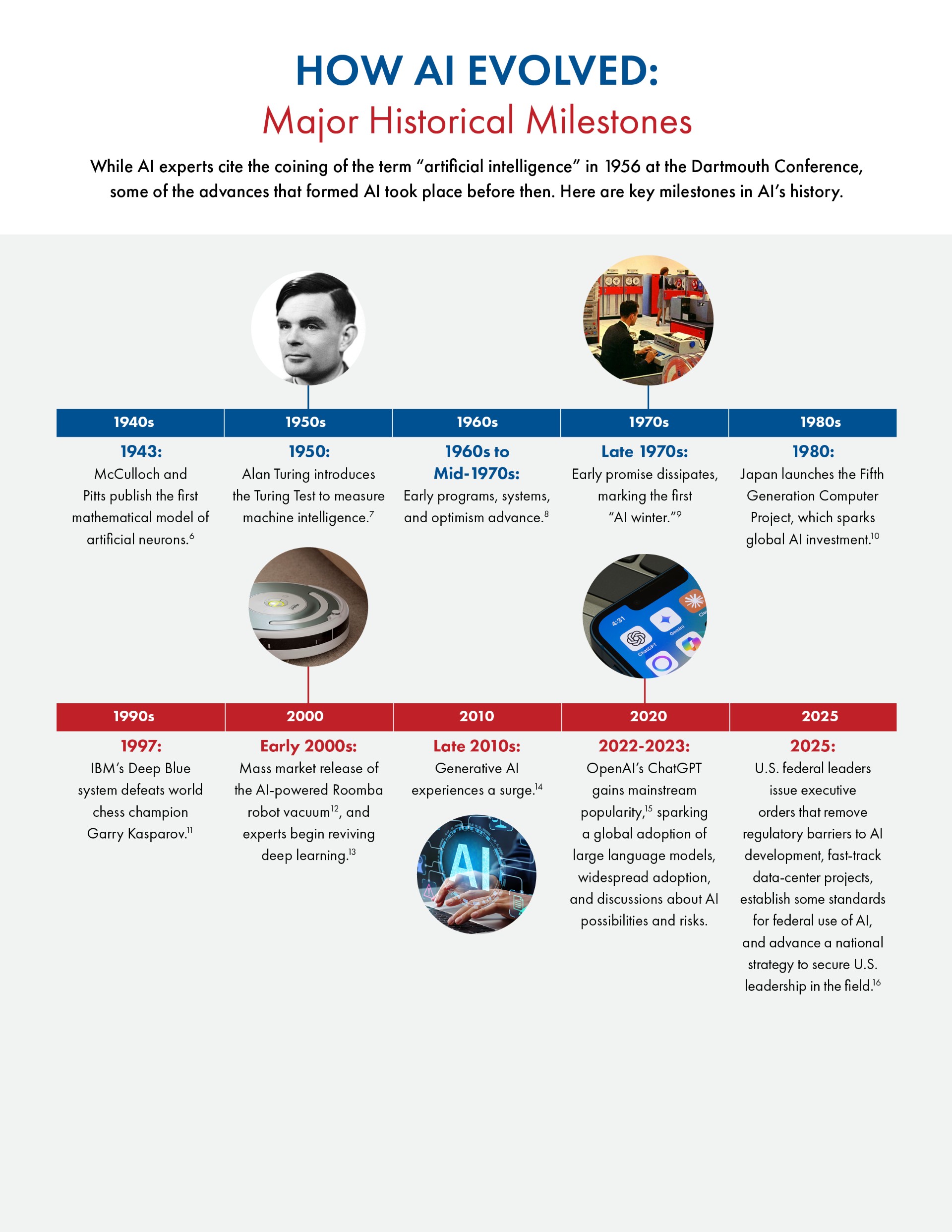
OpenAI’s ChatGPT, released in 2022, propelled generative AI into the mainstream, sparking rapid adoption of large language models and a race for technologies that have reshaped society and fueled new products. Recent federal actions have eliminated regulatory barriers to AI and incentivized its use, aiming to position the U.S. as a global AI leader.
Why AI Matters to Home and Community Based Services
Early evidence suggests that AI would likely augment, rather than replace, home care jobs—largely because home care tasks are primarily physical, interpersonal, and context-specific.
As the second report details, AI has already begun reshaping home care. This publication examines how home care businesses are using AI-based tools across common responsibilities, at the worker and agency level.
For example, home care workers are using AI tools to help clients eat nutritiously and safely. AI facilitates grocery shopping and helps prepare healthy meals. Robotic technologies provide direct feeding assistance. AI also helps workers move clients safely. It reduces the risk of falls by monitoring clients in their homes (with consent) and alerts loved ones when accidents occur. These technologies help workers monitor clients’ vital signs using smartwatches that track health changes. Technologies like smart pill systems and apps ensure proper medication use.
For home care agencies, AI has helped strengthen recruitment by analyzing interviews, matching applicants to roles, and engaging candidates through chatbots and virtual assistance. It has improved staff training, created tailored lessons, monitored progress in skill acquisition, and delivered on-demand learning on the spot, when workers most need it. It’s also helping agencies keep staffing levels stable by using algorithms to forecast when employers will need more or fewer staff. And as this report shows, that’s only the beginning.
A Future with Promise—and Safeguards
Direct support professionals and other experts consulted for this report series see both the promise and the potential risk of AI in home care. In report three, many of the experts felt mixed about AI’s impact on the home care workforce, though they consistently identified AI’s greatest potential in streamlining administrative functions, such as supporting documentation, scheduling, and medication management.
Regarding personal care and workforce development, these experts emphasized that AI‘s greatest value lies in enhancing worker well-being through education and training, building their range of skills, and helping them make more balanced, person-centered decisions. Overwhelmingly, experts rejected the notion that AI could or should replace physical assistance or human judgment—the “personal touch” of home care.
Nearly all experts agreed that the many stakeholders overseeing the home care sector—policymakers, home care agencies, and others—must be well prepared for the intended and unintended impacts of AI on the workforce, both positive and negative.
In this context, the third report proposes that adopting AI in home care will require robust measures to protect privacy, ensure data security, and uphold ethical standards. Since AI can generate false positives or negatives, accuracy, reliability, and transparency must be closely monitored and immediately corrected.
Home care workers might inadvertently rely too much on AI or feel their expertise has been replaced. This underscores the need to ensure workers hold high-quality jobs and that their personal touch and professional experience are recognized as core to their work and careers. Measures will also be needed to protect against technological oversurveillance and reduced autonomy.
Home care agencies will need to carefully integrate AI tools into existing systems and workflows so that staff do not end up taking on additional tasks that make their work more burdensome.
Home care agencies will need to carefully integrate AI tools into existing systems and workflows so that staff do not end up taking on additional tasks that make their work more burdensome. And across all these measures and needs, policy and practice leaders will need to ensure that home care workers, older adults, and people with disabilities are involved in the design of these tools.
Assistive technologies and care robotics must advance in tandem with AI to support, not replace, human care, and any new AI technology should be independently and rigorously evaluated to build trust and protect worker well-being and clients from harm. To have real impact, these tools must be integrated into payment systems and tested through innovation centers—not left to exist only as direct-to-consumer solutions. Finally, all these tools will need to be affordable and reimbursable by public payors, so that people across the economic spectrum benefit.
The story of AI is still being written, and at a time of growing demand for care and intensified workforce pressures, we must all take decisive action to ensure that these technologies support and bring out the best in our humanity.
Let us commit to proactive engagement, stronger policy, and collaborative efforts that prioritize high-quality direct care jobs and person-centered care. Now is the time to act to shape a future where technology uplifts both workers and those receiving care.
Robert Espinoza is the founder and CEO of The CareWorks Project, an advisory and innovation studio helping public and private sector leaders reimagine solutions for the caregiving economy—and a Leadership & Society Fellow at the University of Chicago.
Nicole Howell is the Director of Direct Care Workforce Development at the National Council on Aging, where she leads the Direct Care Workforce Strategies Center in partnership with the Administration for Community Living.
Photo credit: Shutterstock/Unai Huizi Photography