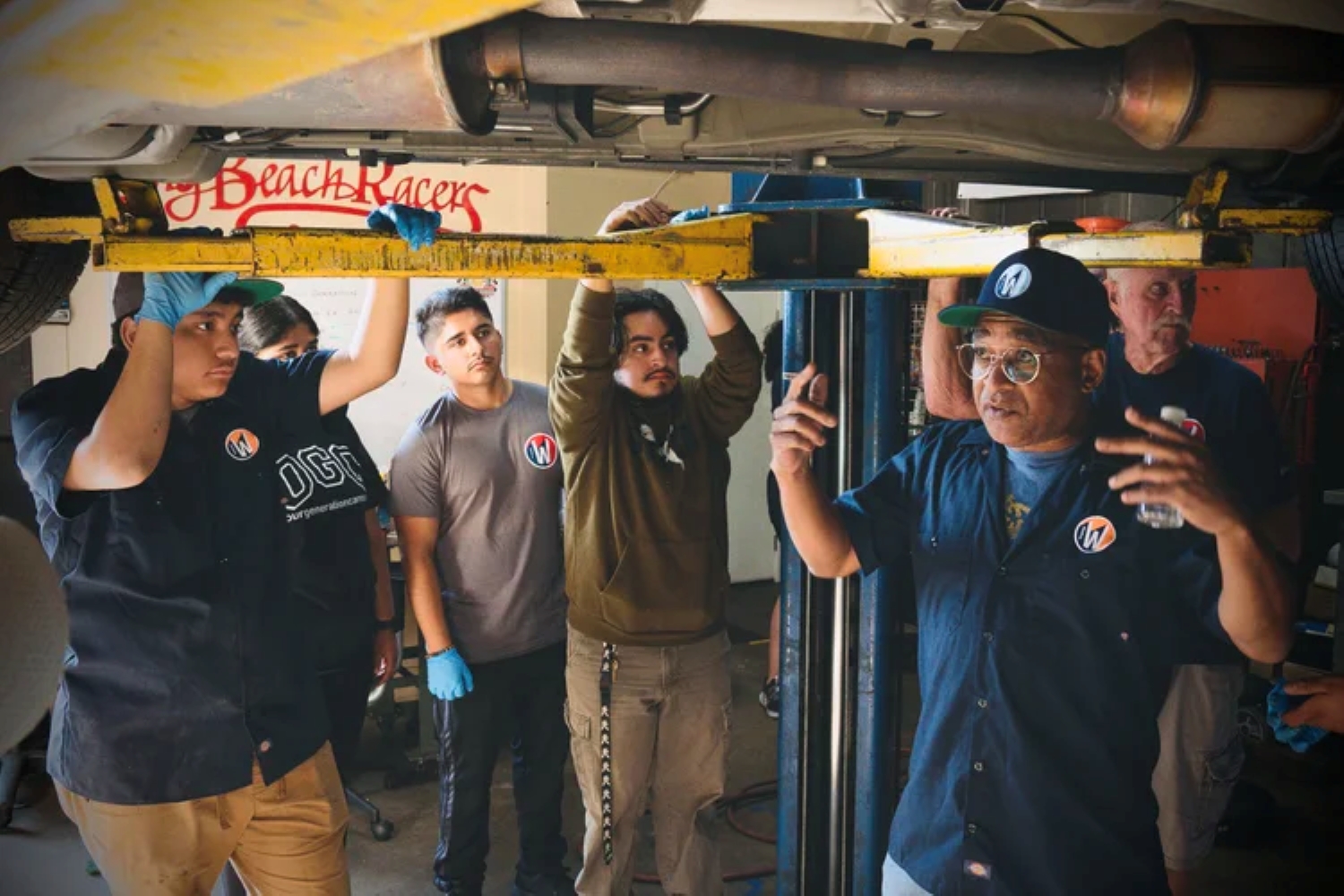

The first image that might pop into many heads upon hearing car buff or mechanic is that of a rather old-school male, possibly macho. But there’s a crew in Long Beach, Calif., who defy this description and then some.
The people behind DSF Werks, an intergenerational community that mentors young men and women who may just be exiting the foster care system or have caught other rough breaks in life, are a philosophical, gentle bunch who just want to help launch kids needing a second chance.
In a state with the highest number of foster care placements, at 38,490 in care in 2024, it feels crucial that organizations like DSF Werks pay attention to those kids who are emancipated from their foster families (and the foster care system) at age 18. Adult mentors are paired with transition-age young people to teach the kids skills related to automotive restoration and/or media arts.
Former foster kid Ayden Mum graduated from an internship with DSF Werks having learned the basics of how to diagnose car troubles, become familiar with all the tools, and gained a lot of hands’ on experience repairing cars. Perhaps more importantly, through DSF Werks Mum said he “feels like I’ve learned how to communicate with people and manage my time properly. They teach you life skills. In my life I never had an opportunity to talk to people and tell them what I do. But,” he says, after 3 months, “I became more articulate, less shy, and less nervous in front of groups of people.”
Motor Mondays, Much More Than a Meetup
On Monday DSF Werks hosts Motor Mondays, a weekly open garage meetup from 5–8 p.m. Mentors and young people show up, hang out, work on projects or personal vehicles and share a meal.
‘This is a community first, one which happens to love cars.’
Program Director and gear head Arnold Pacleb started at DSF Werks as a volunteer because he loved Motor Mondays, which he says holds a special place in the automotive community. When gathered there, he adds that attendees lack the machismo generally embedded in the car culture. Instead, “this is a community first, one which happens to love cars.”
Little did he know that as he built and nurtured relationships with younger adults and older mentors, he found out what real community means: “One that’s embedded in light. Darkness has no place to hide in this community,” said Pacleb, who comes across as an even-keeled man with a spiritual bent.
He’s been impressed with the growth he’s seen in all parties in the garage, young adults and mentors alike.
One mentor is Keith Compton, who manages the LA Metro’s Small Business Council and Capacity Building and Bonding program for construction projects, which makes it sort of incredible that he rarely misses Motor Mondays at DSF Werks. Involved for three years since DSF Werks’ beginning, Compton was invited to volunteer by DSF Werks’ co-founder Joel Lueb, as they had worked together. Compton’s a fan of classic cars and jumped at the chance.
“One thing I’m really proud of is we’ve been able to, through donations, support paid internships. They spend 30 to 40 hours a week at the shop and at the end of the internship [which spans 3 months] we try to help get them a job somewhere,” said Compton.
The volunteers come from all over the LA/Long Beach area, and the goal is not to necessarily get young adults a job in the automotive industry, but to plant seeds so they can grow, and to “get into their heads to believe in themselves that they can do things,” said Compton.
DSF Werks’ first intern got a job with a fleet customization manufacturing company.
“I wouldn’t be talking to you,” said Compton, if I didn’t have people who reached back and helped me. I’m a product of affirmative action, mentors, and the one thing I was taught is you give back. … That’s why I want to touch the lives of these young people who didn’t have parents like I did, and like my kids did,” said Compton.
When asked what he’s seen in the kids at DSF Werks, Compton said, “one person who wasn’t necessarily doing what he should, turned a complete new leaf, in media arts, and is teaching other people how to do that kinda thing now.”
‘It became a family and a community I was given, rather than being around others who didn’t want anything good for themselves. It’s so different from what I was used to.’
“There have been lots of success stories, not just doing something they weren’t doing before, but changing actual behavior, investing in themselves for a greater, more tangible future. That all comes from Monday nights—stopping, assessing the situation, finding out what the instructions are, what are the next steps, and having the discipline and courage to do it,” added Compton.
Motor Mondays is also a safe space where kids don’t have to work on cars, they can just come and sit and watch and eat a meal, and they can come back as often as they want. When Compton sees someone who doesn’t look as if they’re having much fun and just want peace, he says he leaves them alone to let them have that space. Eventually, they come around to chatting.
Belonging to a Community
Pacleb hadn’t originally realized that his favorite part of the job would be working with the young adults, who come in “so fearful and full of doubt. For them to come in that way, and then the light just gets brighter and brighter, and the belief [in themselves] just opens up … They come to love welding and fabrication,” he said. Even those who’ve never used a welding tool end up being able to build stuff.
The mentors also “teach them how to learn,” he added. The 3-month internships go by too quickly for Pacleb, but in that time they’re still able to “embed the character traits that will take you far in life—like showing up on time, being willing, having a good, positive attitude. I love that I get to intrigue them with what I’m still passionate about.”
Motor Mondays seems to provide a kind of magic, or as Pacleb put it, “It’s a beacon of light in a world where there is so much dark. It’s a dose of what everyone really needs and is lacking, which is community, relationships, a chance to be authentic, in a place where no one judges. You can be who you are and be accepted and loved for who you are.”
Mum, reflecting on his time there, said, “when I first started I just looked at it as an opportunity to make money—quick money—it was just a job. In the area where I was raised there’s lots of violence and crime, gangs, and I was falling toward that life. Later on, after being at DSF Werks, I learned that I liked wrenching on cars, it became a family and a community I was given, rather than being around others who didn’t want anything good for themselves. It’s so different from what I was used to.”
Mum explained that Pacleb taught him metal fabrication and sewing, but something just “spiked in him” when he was introduced to welding. “Welding, this is my dream,” he said. “DSF opened my eyes and showed me there’s more to this life than being a Cambodian kid in Long Beach.”
Which is exactly the organization’s aim.
Alison Biggar is ASA’s editorial director.
Photo caption: Mentor Keith Compton, far right, gesticulates as he explains the in and outs of working on a car at DSFWerks’ Motor Mondays.
Photo credit: Courtesy DSFWerks.