
This article is one of four published in a collaboration between the American Society on Aging’s Generations Now blog and the Department of Journalism in Boston University’s College of Communication. The student journalists are members of Professor Deborah Fountain’s Online Journalism class for graduate students.
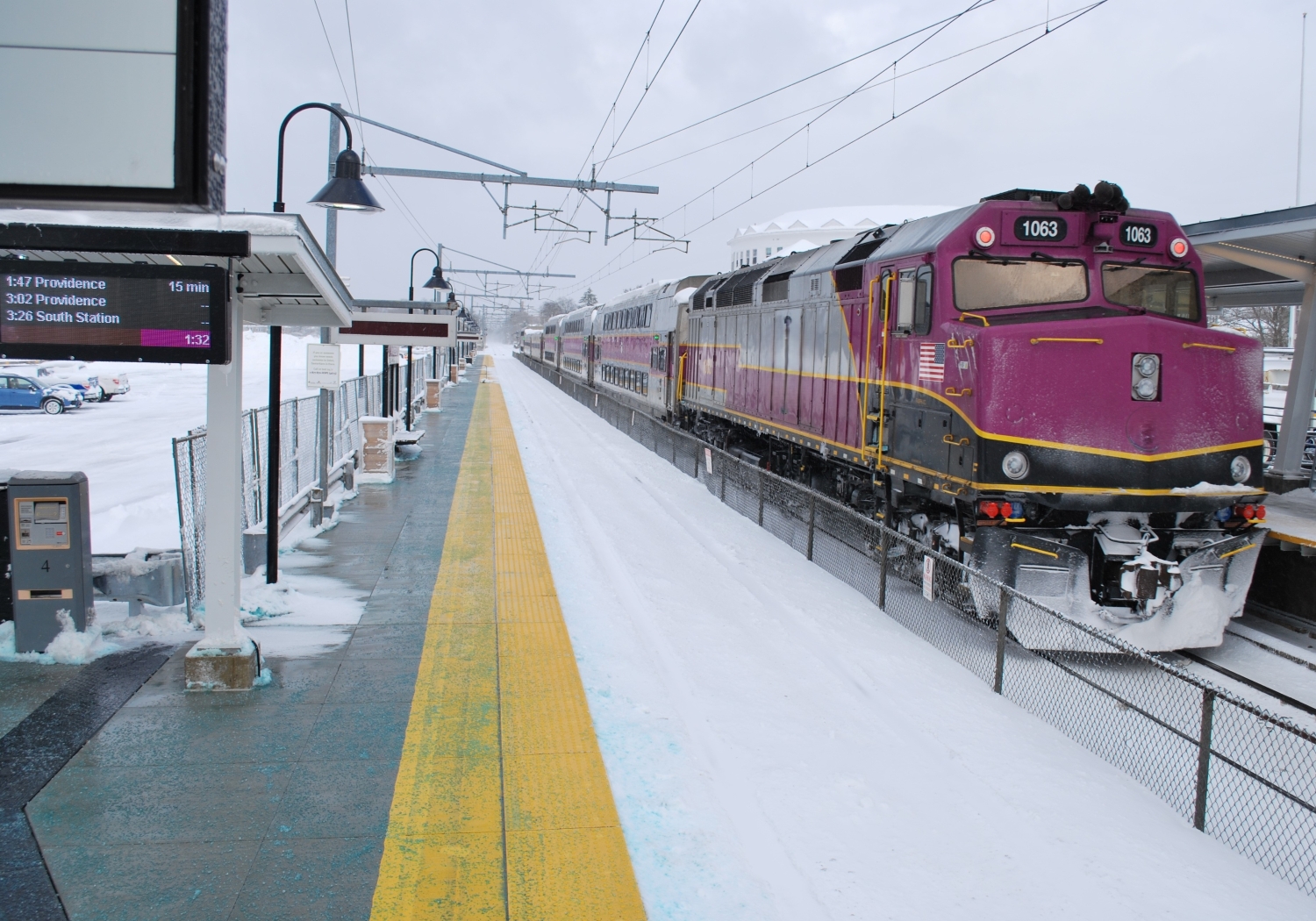
Andy Foreman, 61, is blind and takes the Massachusetts Bay Transportation Authority’s (MBTA) Commuter Rail train from Kingston to South Station every day.
“To this day, the stop announcements are an issue,” Foreman said.
Instead of being able to relax and enjoy his ride to and from work, Foreman is constantly wondering when the next stop will be.
“When I need to go to the seventh stop from wherever I’m coming from,” Foreman said, “I count.”
Too often, he has found himself either on the wrong train or missing his stop.
“It affects people going to dinner or going to the movies, or just living life, [too],” he said.
Foreman said that he “wants to hold the Massachusetts Bay Transportation Authority (MBTA) accountable when they make mistakes.” This led him to sue the MBTA.
Foreman, one of 11 riders who partnered with the Boston Center for Independent Living (BCIL), filed the Joanne Daniels-Finegold lawsuit in 2002. The suit claimed that the MBTA failed to comply with the Americans with Disabilities Act (ADA). The lawsuit was settled in 2006, and it provided a framework for the MBTA to eventually become ADA-compliant.
This lawsuit also led the MBTA to create the Riders’ Transportation Access Group (RTAG) in Massachusetts. RTAG’s bylaws state their purpose is to “advise the MBTA on transportation matters affecting people with disabilities and seniors.”
In addition to RTAG, the MBTA established its Department of System-Wide Accessibility (SWA) to oversee ADA integration strategies for MBTA projects, under the terms of the lawsuit’s settlement. Under the SWA, the MBTA has increased the number of station elevators, built and launched a fleet of ADA-accessible buses, and installed automatic door openers at stations. The MBTA also established guidelines for outreach and education to advocate for the changes RTAG is spearheading.
‘You miss your meetings. You miss seeing your friends. You’re like an hour late. It’s horribly inefficient.’
Katarina “Kat” Torres Radisic, a community organizer and facilitator with RTAG, recognizes that a lot of work remains, both at the MBTA and for public transportation in general. One of the settlement terms in the Daniels-Finegold Lawsuit addresses platform gaps, an issue that persists today.
Over the past couple of years, the platform gaps, specifically along the Orange Line, have gotten worse,” Radisic said. “It is a safety hazard to riders who use wheelchairs and other mobility devices.” The MBTA’s short-term solution is to issue “bridge plates,” metal plates that can close the gap between the train platform and the train cars. The long-term solution would be to shut down the Orange Line and modernize the entire southwest corridor, Radisic said.
The MBTA in Boston is not the only public transportation system addressing accessibility gaps. Cities like New York City and Chicago are also attempting to improve their transportation infrastructure for older riders.
The New York Metropolitan Transport Authority (MTA) is the largest public transportation network in the United States. Spanning 5,000 square miles, the MTA has more buses, subway cars and commuter rail cars than all other U.S. public transportation systems.
The MTA has budgeted roughly $6 billion toward accessibility projects since 2020 to make 67 stations and 78 subway elevators ADA-accessible.
While the MTA has a public renovation schedule that provides updates on which stations are operational, some commuters expressed frustration at the MTA elevators’ frequent outages.
“You miss your meetings. You miss seeing your friends. You’re like an hour late. It’s horribly inefficient,” Jean Ryan, a protestor advocating for more efficient elevator maintenance in New York subway stations, said while speaking to AMNY this past March.
In response to these remarks, Quemuel Arroyo, the MTA Chief Accessibility Officer, said the MTA plans to make 43 additional stations accessible by 2029.
In Illinois, the Chicago Transit Authority (CTA) provides a variety of transportation resources for older riders and those who are disabled on all CTA lines. However, roughly 25% of its stations are still non-ADA-compliant, according to its website.
The CTA’s ADA Advisory Committee said it’s working to ensure these stations’ renovations match federal accessibility standards by 2038.
As for the MBTA, Foreman is proud of the work RTAG has done to help make public transportation ADA-compliant, and he is optimistic about the future.
“That would be my hope,” Foreman said. “Not to have the fear of getting lost ever again.”
Lee Dwyer and Peter Johnson are studying for master’s degrees in Journalism in Boston University’s College of Communication. Dwyer works as a multimedia journalist telling visual stories about grassroots solutions and local organizations in Boston.
Photo caption: The Boston MBTA Commuter Rail train in winter.
Photo credit: Shutterstock/The Global Guy