
Long-term care is one of the most personal and consequential choices that people make—not just for themselves, but often for older parents, spouses and loved ones. The decision about where to receive care, and what type of care is most appropriate, can be emotionally overwhelming. Families want one thing above all else: accurate, clear and trustworthy information.
For Ohioans, a new tool called the Long-Term Care Quality Navigator provides support for this important decision. Ohio’s long-term care infrastructure is substantial and growing. With more than 900 nursing homes (about one-fifteenth of all nursing homes in the country), and more than 800 assisted living facilities, Ohio must be positioned to help older adults and their families make informed choices about their long-term care needs.
In 2023, Ohio took a bold step toward transforming how families make these decisions. When Governor Mike DeWine created the Nursing Home Quality & Accountability Task Force, he sent a clear message that improving long-term care quality and transparency would be a statewide priority. The Task Force was chaired by Ursel J. McElroy, Director of the Ohio Department of Aging (AGE).
Over several weeks, the Task Force traveled across Ohio, listening to residents, family members, facility staff, administrators and advocates. “We had a unique opportunity to go beyond simply listing what the challenges are, and instead to help drive solutions,” said McElroy. “One piece of feedback came through loud and clear: Ohioans needed an easy way to access reliable, facility-specific information about nursing home quality.”
That request became the foundation for what is now one of the state’s most innovative public tools.
From Community Feedback to a Statewide Resource
One of the biggest action items from the Task Force listening sessions was to create a one-stop shop public-facing dashboard that could present detailed, up-to-date quality information about nursing homes in Ohio. Families wanted more than scattered reports or complex rating systems; they wanted a simple, centralized place to compare facilities, understand quality metrics, and make confident decisions.
In 2024, that vision became a reality with the launch of the Nursing Home Quality Navigator. Later that same year, it earned a national award for data innovation from the National Association of State Chief Information Officers (NASCIO), validating Ohio’s commitment to making long-term care more transparent and accessible.
But the innovation didn’t stop there.
Introducing the 2025 Long-Term Care Quality Navigator (Version 2.0)
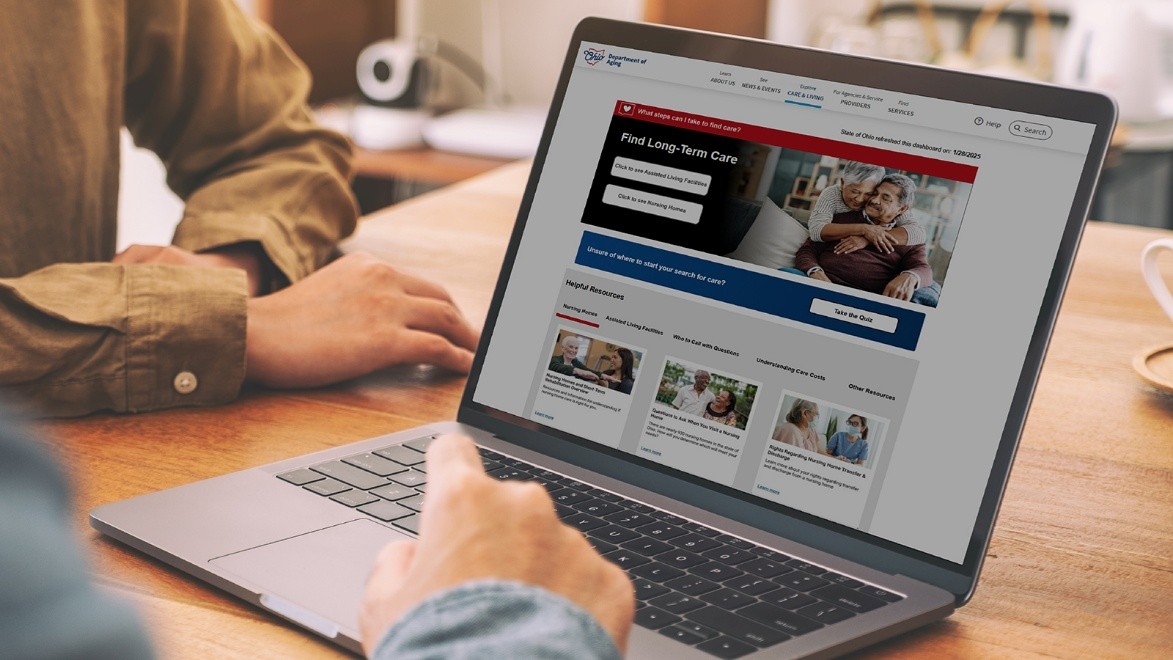
In 2025, AGE built upon the Navigator’s success by releasing an enhanced and expanded Version 2.0—now called Ohio’s Long-Term Care Quality Navigator.
This upgraded version represents a major leap forward in scope and usability:
1. Complete Coverage of Long-Term Care Facilities
Version 2.0 includes every nursing home and every assisted living facility in Ohio—more than 1,700 facilities statewide. This expansion makes the Navigator a comprehensive, user-friendly, one-stop resource for anyone exploring long-term care options.
2. More Data, More Depth, More Clarity
The updated Navigator features an even larger set of quality measures, inspection results, location, and resident/family experience information. It is designed to be easily understood by the public, while remaining detailed enough for professionals.
3. A New Care Quiz
Not everyone knows which type of long-term care setting is right for them. Assisted living? Skilled nursing? Memory care? Home- and community-based options?
‘The updated Navigator features an even larger set of quality measures, inspection results, location, and resident/family experience information.’
To help with this, the Navigator now includes an interactive quiz that guides users toward the type of care that best matches their needs.
4. A Stronger, User-Friendly Design
The tool is clearer, faster and easier to navigate—something especially important for older adults, caregivers and busy family members making time-sensitive decisions.
Why This Matters: Making Ohio the Best Place to Age in the Nation
Ohio is committed to being the best place to age in the nation. High-quality data and transparent reporting are essential parts of that vision. By empowering residents with better information, the state helps families and older adults make confident and informed care decisions with clarity and peace of mind.
The Long-Term Care Quality Navigator does three important things:
- Empowers Families: It gives Ohioans the information they need to compare care options based on quality, safety, resident satisfaction and more.
- Supports Accountability: Facilities can see how they compare to others across the state, reinforcing a culture of quality improvement.
- Drives Systemwide Excellence: By making performance data publicly available, Ohio fosters an environment where excellence becomes the expectation.
The Road Ahead
The creation and evolution of the Navigator represent more than a new dashboard—it represents a cultural shift in how Ohio approaches long-term care. What began as a recommendation from community listening sessions has transformed into a powerful statewide resource that continues to grow and evolve.
“When making one of the most important decisions about their future, Ohioans deserve to have correct, current information at their fingertips. ‘Version 2.0’ of the Navigator provides just that, bolstering AGE’s goal of making Ohio the best place to age in the nation,” said Director McElroy.
As Ohio’s population ages and long-term care needs increase, tools like the Navigator will play an increasingly important role in helping families navigate choices with confidence, clarity and peace of mind. With continued updates and improvements, the Long-Term Care Quality Navigator stands as a model for other states looking to strengthen aging services. Ohio’s leadership in this area demonstrates how states can innovate and collaborate to better support their older populations.
This is one more way Ohio is leading the nation in its commitment to older adults—and ensuring that every Ohioan has the opportunity to age with dignity, independence and quality care.
Ohio is one of seven states participating in the West Health and National Academy for State Health Policy State Nursing Home Learning Collaborative, focused on improving quality of care in nursing homes, exploring innovation in payment, and addressing administrative and cost efficiencies.
Mihret Walelgne Menberu, MPA, is a research associate for the nonprofit, nonpartisan West Health Policy Center, and Brianne Betts, JD, is Chief Communications Officer at the Ohio Department of Aging.
Don’t miss the Feb. 11, 2026 Winter 2025–26 issue of Generations Journal for more efforts like this one in Ohio.
Photo credit: Courtesy of the Ohio Department of Aging.