
Editor’s Note: The John A. Hartford Foundation is collaborating with ASA RISE to advance equity through a series of blog posts in support of the development and dissemination of equity-related, partnership-based thought leadership through ASA’s Generation platform. This blog post is part of that series.
Since childhood, I’ve worn glasses. Without them, the world around me is blurry unless it’s within a foot of my face. Putting them on brings everything into focus—suddenly vague shapes resolve into the distinct details that make up the whole. I might recognize the multicolored blob by my front door as a coat rack, but with my glasses I can see each jacket, scarf and hat that give that blob its mountainous shape.
Participating in ASA RISE was like putting my glasses on for the first time. On my first day as a fellow, I was invited to consider a metaphor: looking in a mirror and looking out of a window. It was an opportunity to realize this experience would give me deeper insight into myself (via the mirror) and deeper clarity about the world around me (via the window). Each perspective sharpens the other. How does what I see inspire change? What actions does it call me to take? Who else must be involved—and just as importantly, whose voice might be missing?
This introduction to liberatory design (an equity-centered, creative problem-solving framework designed to address systemic oppression and redesign inequitable systems with an equity framework) informs how I support my colleagues and the constituents we serve in my role as a clinical team lead at the Alzheimer’s Association 24/7 Helpline.
‘Many callers reach out to us as experts and expect us to tell them what to do.’
The Helpline supports people living with Alzheimer’s and other dementias, as well as the friends and family who care for them. Each person who contacts us is complex. As we often say on the helpline, “If you’ve met one person with dementia, you’ve met one person with dementia.” So many other factors shape their lived experiences. Layered on top are inequities rooted in racism, ageism, ableism, classism, language barriers, immigration status, LGBTQ+ identity, and geographical isolation. An equity lens allows us to see each individual inequity on the rack, not just the layered mountain they create.
Collaborate and Transform Power
One of the key components of liberatory design is seeking liberatory collaboration. Many callers reach out to us as experts and expect us to tell them what to do. That can create a power dynamic, where it’s understood that we know best. Instead, we work to encourage a collaborative spirit. Yes, we know a lot about dementia and have resources available. But callers know themselves best. They know what they want, their strengths, and the obstacles preventing them from achieving their goals. By approaching conversations with an eye toward what all parties bring to the conversation, we can start to frame strategies that feel tailored to the caller’s needs.
Let’s take a fictitious caller named Jane. She is worried about her dad living alone, especially after noticing he has lost weight. She shared that she lives about an hour away from him, and her work schedule makes it difficult to check on him more than once a week. Meeting her where she is means acknowledging these realities.
Instead of suggesting time‑intensive interventions she cannot realistically take on, we might help her brainstorm who else could be involved or help. Are there other family, friends or neighbors who could stop by regularly or take him out for a meal? What about any adult-day programs that could give him socializing opportunities and regular meals? Are there community programs that could meet his needs? We ask open‑ended questions, honor Jane’s cultural and personal values, and co‑create next steps with her instead of dictating them.
Collaborating with John, who wants to plan for his own journey through Alzheimer’s, means honoring his autonomy and expertise in his life.
Another fictitious example is John, who was recently diagnosed with Alzheimer’s and wants to plan for his future. Collaborating with him means honoring his autonomy and expertise in his own life. Asking about his hopes, goals, and what meaningful support looks like for him, respects how he envisions a meaningful life.
Through this collaborative approach, patterns often emerge. Within our team, transforming power means creating a culture where the team feels supported, heard, and empowered to make decisions. When a team member notices trends—such as callers from certain communities experiencing barriers with specific programs—we encourage them to bring up those insights. Power is shared when all team members can influence how we respond to constituents, improve systems, and challenge inequities. The mirror-and-window cycle continues.
Embracing the Mess
Liberatory design also invites us to embrace complexity. This resonates powerfully when considering the complexity of dementia care. Equitable access to services is not only complicated—it is inequitable by design.
Rural callers may have no memory care specialists within 100 miles. Urban callers may face waitlists of six months or more for diagnostic appointments. Some callers struggle to find providers who speak their preferred language. Professional in‑home care may be unaffordable, leaving family caregivers to piece together care while managing their own health, employment and financial pressures.
On the helpline, embracing the mess means holding space for the frustration and injustice inherent in these realities. Someone might say, “I’ve called every neurologist within driving distance, and no one is accepting new patients.” We validate their reality. Sometimes embracing the mess means simply acknowledging, “You’re doing the best you can—and you don’t have to navigate it alone.”
Seeing with a Clearer Lens
Using an equity lens doesn’t mean we have all the answers. It means we commit to seeing clearly, listening deeply, and designing with—not for—the people we serve. Just like putting on glasses for the first time, the world becomes sharper. And once we see with that clarity, we cannot go back. We can only continue working toward a world in which every person facing dementia has the opportunity to live with dignity, connection, and equitable support.
Jocelyn Powell, MSW, is a clinical team lead at the Alzheimer’s Association’s 24/7 Helpline, and an alum of ASA RISE’s Cohort 2.
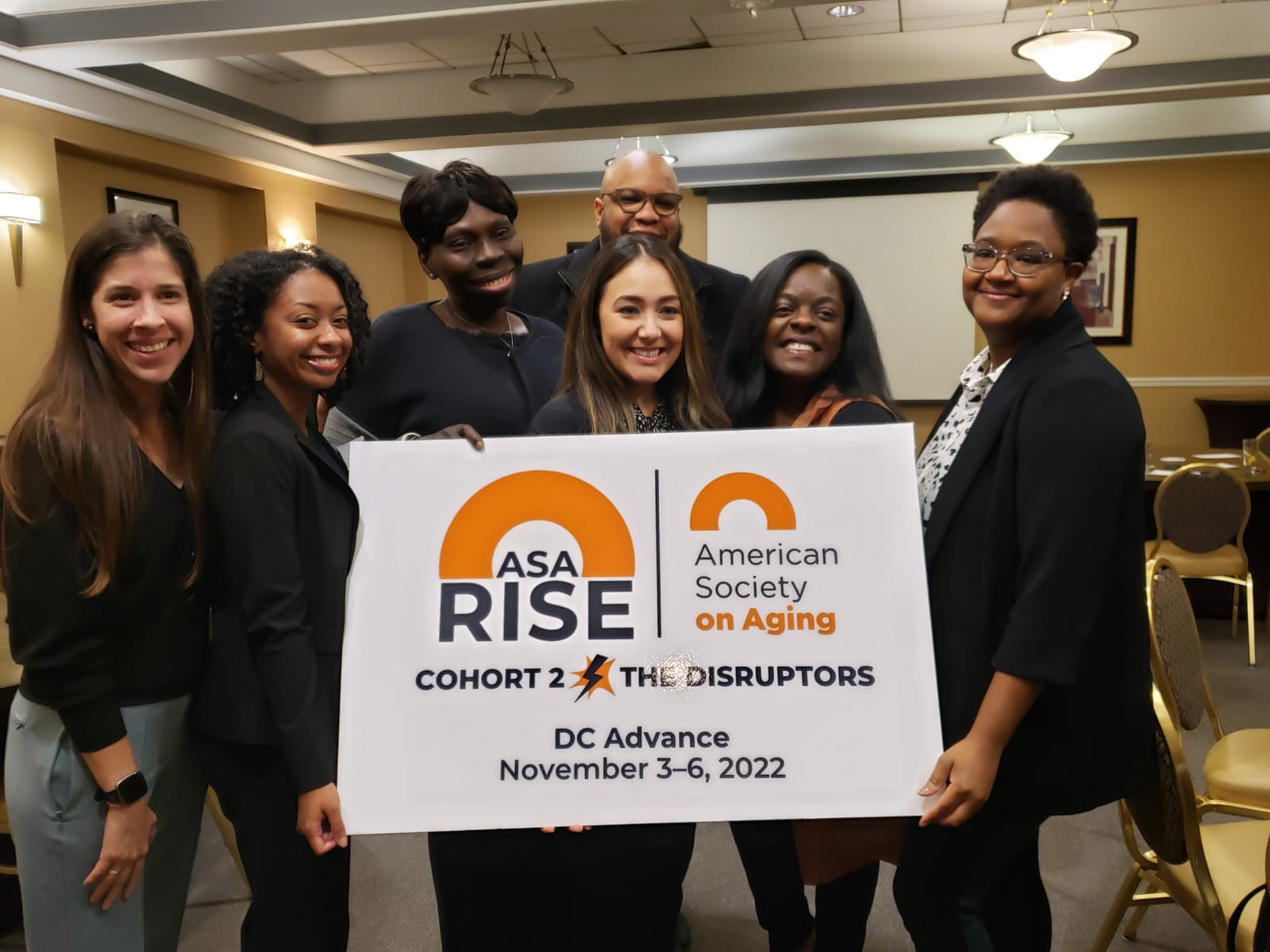
Photo caption: From right to left, Jocelyn Powell, Ashley Stevens, Maurice Haskins, Yesenia Jones, Lisa Stovall, Christine Holmes, and Nadia Velasquez at an ASA RISE DC Advance meeting in 2022.
Photo credit: Courtesy Jocelyn Powell.