
Editor’s Note: The John A. Hartford Foundation is collaborating with ASA RISE to advance equity through a series of blog posts in support of the development and dissemination of equity-related, partnership-based thought leadership through ASA’s Generation platform. This blog post is part of that series.
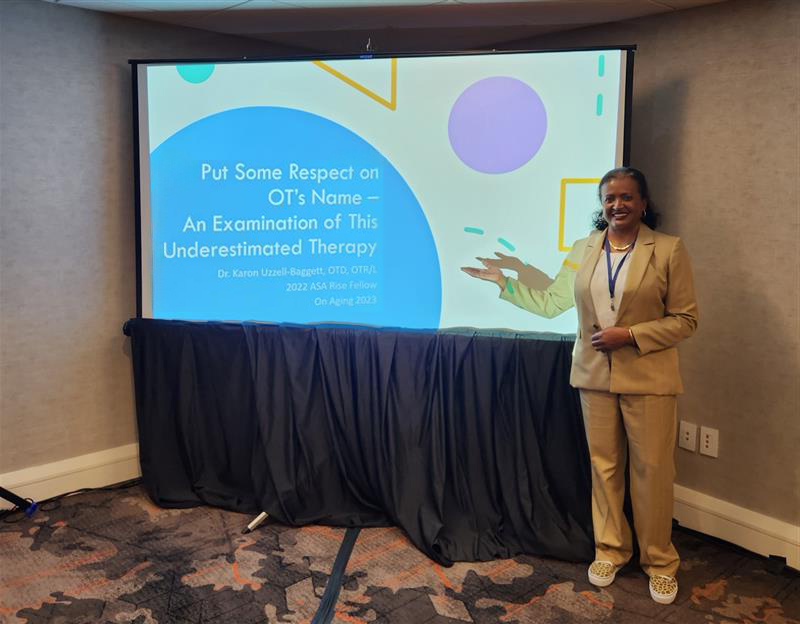
Three years have passed since I realized my dream of presenting “Put Some Respect on OT’s Name,” at a national conference, and I have the American Society on Aging (ASA) to thank for that. This opportunity came after completing an enriching experience as an ASA RISE fellow. The program gave me the chance to discuss what I am passionate about at this phase of my life—exploring areas of Occupational Therapy (OT) outside the traditional settings of hospitals, rehabilitation facilities, and schools, and improving health outcomes, especially for older adults who live in the community.
How I came to be an Occupational Therapist aligns with my first engagement with ASA. I have always been interested in lifelong learning and appreciate its positive impact on brain health. After retiring from the U.S. Air Force and while working as an administrator at a local college, I returned to school to pursue a doctorate.
I may have been 30 years older than the men and women in my cohort, but I wanted to show them the importance of pursuing additional education at any age. OT intrigued me because of the field’s expansiveness and its ability to positively impact the lives of individuals, groups and populations. I’ve always known that working with older adults is where my passion lies and decided to supplement my assigned education in this area.
I believe when an opportunity presents itself, you should take your shot at it, an attitude I had when I applied to be a member of the first cohort of the ASA RISE program.
I discovered ASA and its excellent asynchronous courses held in conjunction with the University of Southern California’s Davis School of Gerontology. I took several and thoroughly enjoyed them. I engaged further with ASA by applying to be part of its LEARN Council, which was dedicated to exploring lifelong learning. Being on a committee led by Dr. Sandra von Doetinchem was an enlightening experience.
I firmly believe that when a wonderful opportunity presents itself, you should take your shot at it, and that’s the attitude I had when I applied to be a member of the first cohort of the ASA RISE program. I will always be extremely grateful for the opportunity to learn from outstanding experts in equity like Patrice Dickerson and Cynthia Banks. These women pour their whole hearts into developing leaders who will advance the ideals of equity and belonging for older adults. I was blessed to work with them and have continued my engagement now as a cohort ambassador working with subsequent ASA RISE cohorts. Fostering a diverse community and giving back is what ASA and those organizations who support the ASA RISE program do so well.
Educating Others on Occupational Therapy
I wanted to give my conference presentation because I am equally passionate about educating people and groups about all the areas where OT can positively impact people’s lives, especially older adults. I started my private practice to pursue this goal and feel blessed to have had the opportunity during my presentation to discuss what OT is, what it is not, and how it can help community-dwelling older adults. The American Occupational Therapy Association defines OT as “the therapeutic use of everyday life occupations with persons, groups, or populations (i.e., the client) for the purpose of enhancing or enabling participation.”
This allied health profession has existed for 109 years, and its awareness month is typically observed in April. OT’s collaborative focus while developing a care plan, creating client-centered goals and its foundation in mental health, aligns perfectly with the goals of age-friendly healthcare. OTs are powerful partners on interdisciplinary teams in acute and rehabilitation hospitals, working with instructors and social workers in schools, and other settings. In the community, nonprofits also benefit greatly from partnering with OTs.
It can feel Sisyphean to educate people and groups about OT and practice in community-based settings, where services aren’t readily reimbursed by insurance.
In my practice, I focus on helping people, especially older adults, remain in their homes and communities for as long and as safely as possible. Our country’s veterans, of which I am one, are another group I strongly believe can benefit from OT. I have had the opportunity to develop several presentations to educate other OT practitioners on the physical and psychosocial factors affecting active-duty personnel, veterans and their families. This has been truly rewarding work that I hope to grow.
Despite some successes, it can feel like a Sisyphean task to educate people and groups about OT and practice in community-based settings where services aren’t readily reimbursed by insurance. There is also age-old confusion with another allied health profession, Physical Therapy (PT), which has greater name recognition with the general public. OT and PT closely collaborate in many settings, but we are two distinct professions.
From my personal experience, some medical professionals don’t realize that OT can benefit patients with certain conditions. Last year as I was dealing with both my parents’ deteriorating health, I had to keep advocating that one parent dealing with the effects of vascular dementia and the other one on hospice at least be screened by an OT for potential treatment. This only complicated what was already an extremely stressful situation as I was caregiving long-distance, straddling two states simultaneously to reach both parents.
Situations like mine have only fueled my hope and desire to expand OT’s use in the community for a multitude of individuals and groups. I also want to show the benefit of OT in the world of work where its person-centered approaches can benefit employees dealing with various physical and psychosocial issues.
If I start to get discouraged, I go back to something I took from my time as an ASA RISE fellow. As each virtual session was drawing to a close, Cynthia Banks would end it with a wonderful quote. One she recited to us by Edgar A. Guest, a British-born American poet, always serves as an inspiration:
“When things go wrong, as they sometimes will,
When the road you’re trudging seems all uphill,
When the funds are low and the debts are high,
And you want to smile but you have to sigh,
When care is pressing you down a bit—
Rest if you must, but don’t you quit”
Dr. Karon Uzzell-Baggett, OTD, OTRL, SPHR, SHRM SCP, is a certified and licensed Occupational Therapist in Nashville, Tenn., with a passion for working with older adults, women, veterans and people of color. She is also a wife, mother, stepmother and retired United States Air Force officer. Uzzell-Baggett started her private practice, Specialized Occupational Therapy Services LLC, to address preventive health issues and create better health outcomes for clients and groups living and working in the community. Uzzell-Baggett is an ASA RISE alum from Cohort 1.
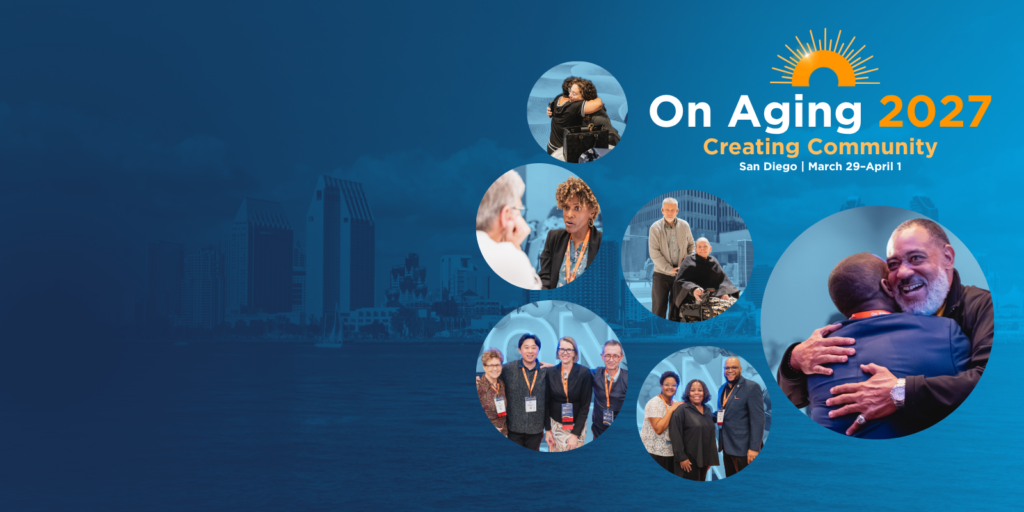
Photo caption: Karon Uzzell-Baggett at On Aging in 2023.
Photo credit: Courtesy Karon Uzzell-Baggett.