


Abstract
Faced with long wait times to connect individuals with essential in-home care services, Council on Aging of Southwestern Ohio (COA), the Area Agency on Aging (AAA) serving five counties in southwest Ohio, decided to take a pioneering approach to connecting clients with care providers. Through its wholly owned subsidiary and innovation incubator, home52, COA created AddnAide, an app that taps technological efficiency to help more individuals participate in self-directed care programs. In doing so, COA is transforming the way care is managed and delivered to improve the efficiency of self-directed care programs.
Key Words
innovation, self-directed care or person-centered care, home- and community-based care or long-term services and supports, Area Agency on Aging, technology, direct care workforce, care coordination, access to care
In 2017, Council on Aging of Southwestern Ohio (COA), along with other administrators of home- and community-based services (HCBS), began to feel the impact of a shrinking home-care workforce. The shortage was impacting COA’s ability to deliver safe, reliable and cost-effective services through its programs, including statewide Medicaid waiver programs and local programs funded through county tax levies.
The workforce shortage was exacerbated by the COVID-19 pandemic; by September 2022, more than 2,200 individuals (13.5% of COA’s total census) enrolled in HCBS in COA’s service area were not matched with a home-care worker. Most of these—1,760—were enrolled in COA’s Elderly Services Program, a program funded by local tax levies for older adults not eligible for Medicaid (Council on Aging, 2022).
“More than half of the individuals we serve are enrolled in the Elderly Services Program,” said COA CEO Suzanne Burke. “As the administrator of this locally controlled program, we were in a unique position to find and test innovative solutions that could help us lessen the impact we—and our clients—were feeling from the workforce shortage.”
COA worked closely with its service provider network, including home health agencies, over several years to implement changes that could improve the quality of care for older adults, while also supporting and growing the local home-care workforce. This included recruiting new providers and wage increases for home-care workers. Training and scheduling requirements also were updated to eliminate restrictive policies and improve service delivery.
Focus groups conducted with home-care workers revealed pride and satisfaction among the workforce. “It’s a good day for me when I’m able to make someone’s day a little brighter,” one worker reported. However, workers also shared frustration with a lack of control over scheduling and communication between members of their clients’ care teams.
Though this work was revealing and improved service delivery, it had no impact on the local workforce shortage.
COA saw another opportunity in self-directed care, an option available to clients enrolled in the Elderly Services Program, as well as in many Medicaid waiver programs. Self-directed care allows clients, or someone they designate on their behalf, to hire their own home-care workers instead of using a traditional home-care agency. The client becomes the employer and makes decisions about their care, including who provides it, and when and where they receive it.
According to AARP and Applied Self-Direction, since 2019, self-directed care models have increased in use by 23% (Applied Self Direction, 2024). After educating Elderly Services Program clients about this service option, from 2020 to 2022 COA saw a 43% increase in the use of self-directed care (Council on Aging, 2020–2025).
Still, several barriers kept clients who could benefit from self-directed care from participating, including a cumbersome, lengthy enrollment process; concerns over managing paperwork and payroll; a disconnected care team; and a limited social network from which to hire a worker.
A New Approach: AddnAide
COA had already begun looking for ways to improve the self-directed care model so more clients could participate. In 2019, the organization partnered with the Live Well Collaborative, a university-based research and design firm, to find a solution that would address pain points identified by home-care workers and clients and attract new people to the workforce, ultimately expanding opportunities for individuals to participate in self-directed care.
‘After two full years in operation (2023–2024), the number of billed self-directed care units in AddnAide increased 298%.’
While Live Well’s research identified several products already available in the private-pay home-care space, nothing existed that could easily be adapted for or integrated into publicly funded home- and community-based programs.
COA has a national reputation for developing innovative products that address challenges and improve service delivery in the HCBS sector. Many of these products were developed through COA’s wholly owned, nonprofit subsidiary and innovation incubator, home52, LLC. Products and services created and launched by home52 are managed and administered by COA staff. home52 developed the concept for AddnAide.
The home52 innovation team, led by COA’s Senior Innovation Designer, Jai’La Nored, envisioned an application (app) that would leverage technology to increase access to self-directed care programs, while also growing the home-care workforce. AddnAide was conceived as a single, secure platform that would enable individuals in need of in-home services to match with potential workers, manage authorized services, and communicate with a fully connected care team.
“We envisioned AddnAide benefiting a variety of stakeholders and addressing a number of pain points,” Nored said. “We wanted to help people connect to care, bring more people into the workforce, and streamline the process behind self-directed care so more people could participate and become managers of their own care.”
Behind the scenes would be a system of checks and balances that could meet the requirements of most publicly funded HCBS providers.
- Responsible stewardship of public funds by having care managers enter and monitor care plan and spending limits.
- Built-in accountability and verification to ensure services are delivered only as authorized.
- Real-time communication between care recipients, home-care workers, family members and care managers to improve the care experience.
- Secure Financial Management Service (FMS) integration to automate payroll processing and eliminate opportunities for errors.
home52 also had an eye on the future. Initially, the project was funded by COA and home52. Once the app was developed, COA applied for and received federal funding to pilot the app in the Elderly Services Program, with the goal of developing a product that could meet the needs of a variety of HCBS programs.
“The vision of AddnAide was never to serve one program and one population,” said COA CEO Burke. “The goal was to have a solution that was adaptable to a variety of funders, programs, and end users.”
Launching an App: Lessons Learned
With the concept developed, in 2020 home52 used a competitive bidding process to find a developer to bring AddnAide to life.
“As an Area Agency on Aging, app development isn’t exactly in our wheelhouse,” Nored said. “Finding a developer and embarking on this process was a classic situation of ‘we didn’t know what we didn’t know.’ Most developers are accustomed to designing and building from the end users’ perspective. With AddnAide, we needed something that would be easy for older adults to navigate, but we also needed the app to align with the requirements and needs of our programs and funders.”
Nored continued, “It was a challenge to find a developer willing to dig in and really understand the space we work in. We had a limited budget and lots of regulatory and compliance requirements to meet. We needed a partner that would bring their expertise to the table but also listen to us as the experts in our space.”
Ultimately, Launch Scout was selected as home52’s development partner. The app was built and tested internally across 16 months and was ready for user testing in 2022. Then, focus shifted to developing an implementation plan.
“We learned quickly that you can’t create an app and expect it to be successful on Day 1,” Nored said. “‘If you build it, they will come,’ did not apply to AddnAide. Our implementation plan went through several iterations before we were able to gain traction and start collecting data that showed we were on the right track.”
Katie Pohlman, principal UX designer at Launch Scout, shared a similar sentiment: “Building software is challenging and is never really ‘done.’ There are always more features on the wish list. You have to get really good at prioritization. Designers and developers can build anything, but it is important to build the right thing.”
‘ “[My aide] does a great job for me—we’re a team,” Dennis added. “It’s gotten so that she just comes in and knows what to do.” ’
The AddnAide implementation team, which included Nored, a project manager, care management staff, marketing support and Launch Scout, learned hard lessons during the app’s implementation in the Elderly Services Program that ultimately served to make the product better for future customers and partners:
- Finding the right messaging and tools to get all stakeholders on board and engaged with the app—including older adults, family caregivers, workers/aides, and care management staff;
- Marketing the product in the community to attract more people to the workforce;
- Finding the correct balance of home-care workers and care recipients in the app to facilitate good matches and get work started quickly;
- Adjusting the onboarding process for workers to facilitate faster employment opportunities, in line with gig-economy expectations;
- Developing tools to help older adults adopt new technologies; and,
- Adjusting care-management infrastructure to build knowledge and focus on engaging with clients most appropriate for self-directed care.
“We realized we needed to adapt our approach to meet the needs of workers, clients, and our care management staff if we wanted to see utilization rates go up,” said Nored. “We came to see all of these lessons as opportunities to collect valuable information and data, which helped us better communicate with all stakeholders and develop a better product.”
AddnAide’s Impact
From the beginning, COA and home52 believed AddnAide had the potential to impact quality, cost and outcomes for its clients, as well as clients of other HCBS program operators. As the number of users in AddnAide grew, data began to support these beliefs.
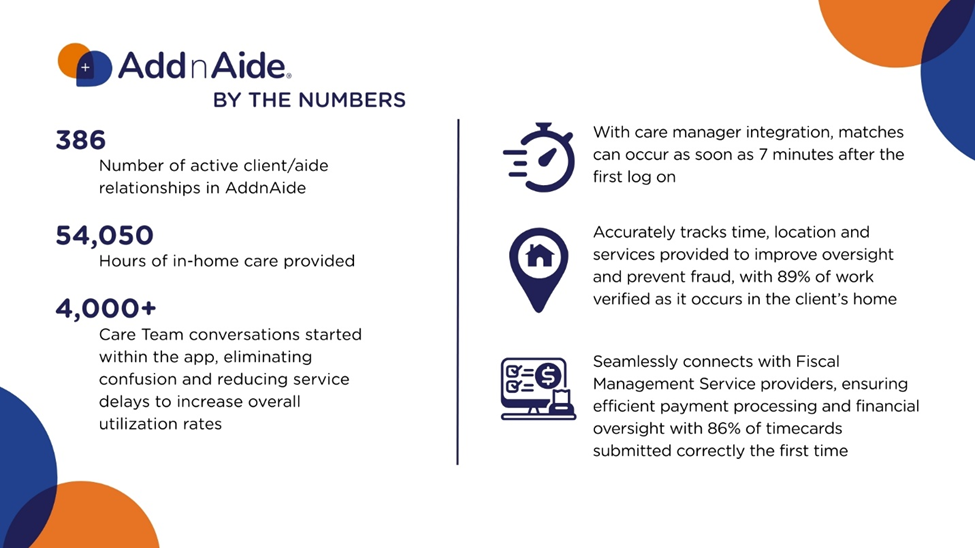
After three full years in operation (2023–2025), the number of billed self-directed care units in AddnAide increased by 298%, with 386 active client/aide relationships and more than 54,050 hours of care provided in the app (see Figure 1, below). And, by the end of 2025, the number of Elderly Services Program clients waiting to match with a home-care provider (via AddnAide or a traditional home-care agency), was 163, a 91% decrease from 2022 (Council on Aging, 2022–2025).
Figure 1: AddnAide by the Numbers
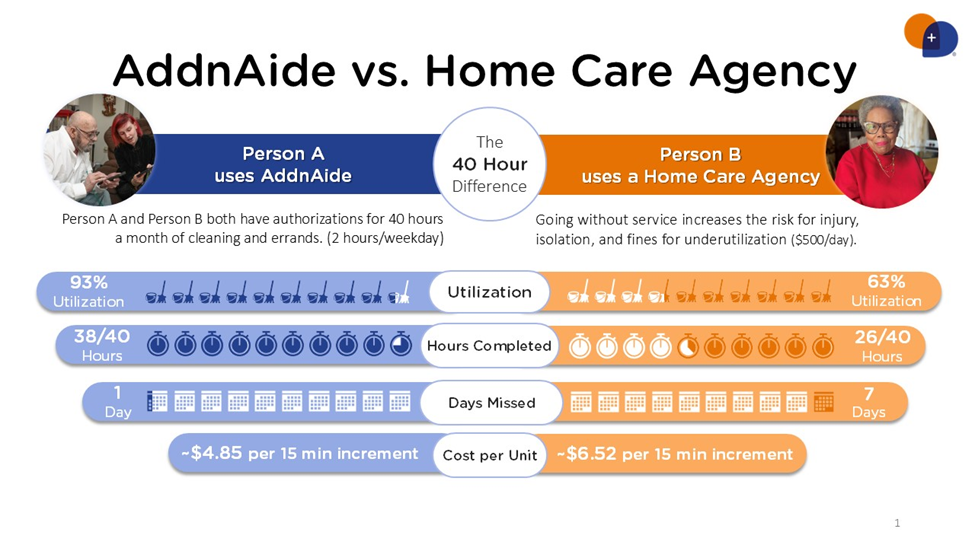
Additionally, when compared to traditional home-care services provided by a home health agency, AddnAide generated (see Figure 2, below; Council on Aging, 2022–2025):
- 30% higher service plan utilization rates,
- an average of 12 more hours of care completed monthly,
- significantly fewer missed days of care,
- a 25% lower cost per unit, and
- lower costs per unit of care delivered.
Figure 2: AddnAide Utilization Rates Compared to Traditional Home-Care Services
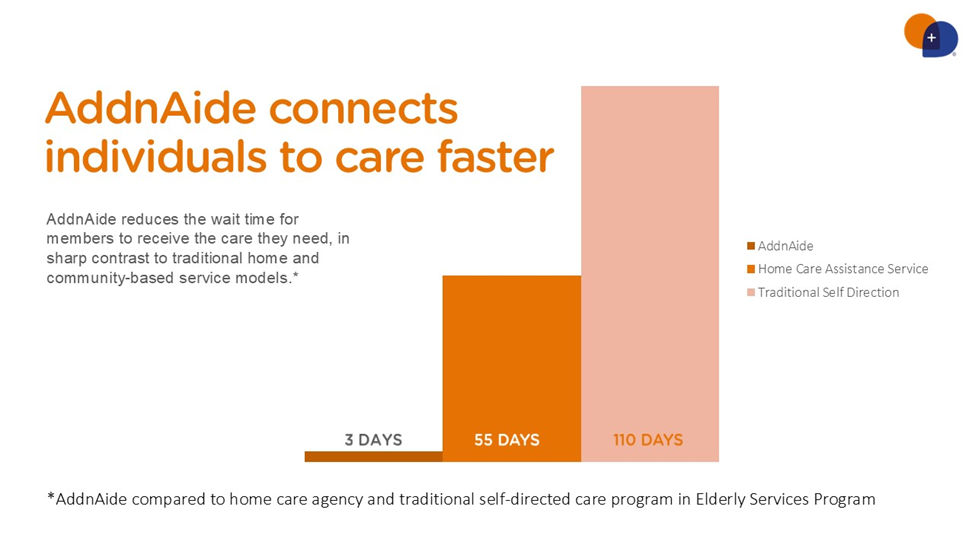
AddnAide reduced wait times for clients in COA’s Elderly Services Program to receive the care they need. AddnAide clients have matched with an aide and started service in as little as three days, compared to 55 days when accessing care through COA’s traditional provider network, and 110 days when utilizing traditional self-directed care (see Figure 3, below; Council on Aging, 2022–2025).
Figure 3: Start of Services
According to Nored, “AddnAide significantly streamlines the process for enrolling in a self-directed care program. The traditional self-direction option in our levy-funded program involves more paperwork than many clients can manage on their own, creating opportunities for error and prolonging the time it takes to begin providing service. For the Elderly Services Program, we’ve created a seamless, fully integrated and supported process within AddnAide that helps clients connect with care faster.”
Finally, AddnAide was successful in growing the pool of available home health aides. Since launch, more than 1,700 individuals have created aide accounts, with about half having some level of certification, including CPR, home health aide, or SNTA certification. Additionally, a smaller number of individuals with aide profiles in the app identified as registered nurses, LPNs, or licensed social workers (Council on Aging, 2022–2025).
AddnAide’s Future
Beyond data, feedback from COA clients indicates the app is having an impact on service delivery and quality of life.
Many COA clients who opted to use AddnAide had grown frustrated with the inconsistent service they received through understaffed home-care agencies. AddnAide provided the platform to find a reliable care provider and the tools to help such clients gain more control over their care.
Dennis, a COA client with COPD, had an aide through a home-care agency. But, due to a shortage of home-care workers, it was difficult to get the consistent service he needed. He was able to use AddnAide to hire his neighbor to provide the services authorized in his care plan. He uses AddnAide to approve his aide’s timecards and schedule their appointments. He also receives messages from his aide and his care manager in the app. “I’m pretty savvy with the app,” he said. “It’s easy—self-explanatory.”
“[My aide] does a great job for me—we’re a team,” Dennis added. “It’s gotten so that she just comes in and knows what to do.”
With a framework built on lessons learned during the app’s rollout in the Elderly Services Program, AddnAide is now adaptable to a wide variety of self-directed care programs and populations. To help organizations see how AddnAide might be integrated into their own programs, COA created a demo environment and video to demonstrate the app’s capabilities, including client/aide matching, establishing employment relationships, managing services, user roles, and real-time care team communications.
AddnAide has been showcased at conferences for state Medicaid directors, as well as for the Ohio Association of Area Agencies on Aging (O4a) and USAging.
Another Ohio Area Agency on Aging began using AddnAide in June 2024 to help clients in their levy-funded program connect with home-care workers. “home52 helped us integrate AddnAide into our region and provided comprehensive training and support to our agency,” said Rachelle Baughn, director of consumer services at Area Agency on Aging, PSA2.
“AddnAide has continued to help provide autonomy to individuals who want to participate in self-directed options, but didn’t have a caregiver in mind to provide their care. It has also facilitated connections that allow members of the community who wish to be caregivers to get involved with our agency,” Baughn said.
In 2025, to meet growing demand for use of AddnAide, COA created a social enterprise to operate nationally, providing flexibility for AddnAide to grow while COA continues to use it at the local level.
“AddnAide is really about more care for more people,” said COA’s CEO Burke. “It connects people who have the desire to manage their own care with a broader community of care providers. In doing so, AddnAide helps more people participate in self-directed care programs and it helps COA and other organizations overcome service delivery challenges, lower costs, and improve outcomes.”
To learn more about AddnAide go to https://www.help4seniors.org/programs-services/get-help-in-home/addnaide/.
Paula Reichle Smith is a senior strategic communications consultant at COA.
Photo credit: Shutterstock/PeopleImages
References
Applied Self Direction. (2024). The 2023 self-direction national inventory self-direction programs. https://appliedselfdirection.com/resources/the-2023-selfdirection-national-inventory-selfdirection-programs#
Council on Aging of Southwestern Ohio. (2020–2025). AddnAide Reporting and Council on Aging Key Indicator Report [Proprietary Data]. Council on Aging of Southwestern Ohio.